
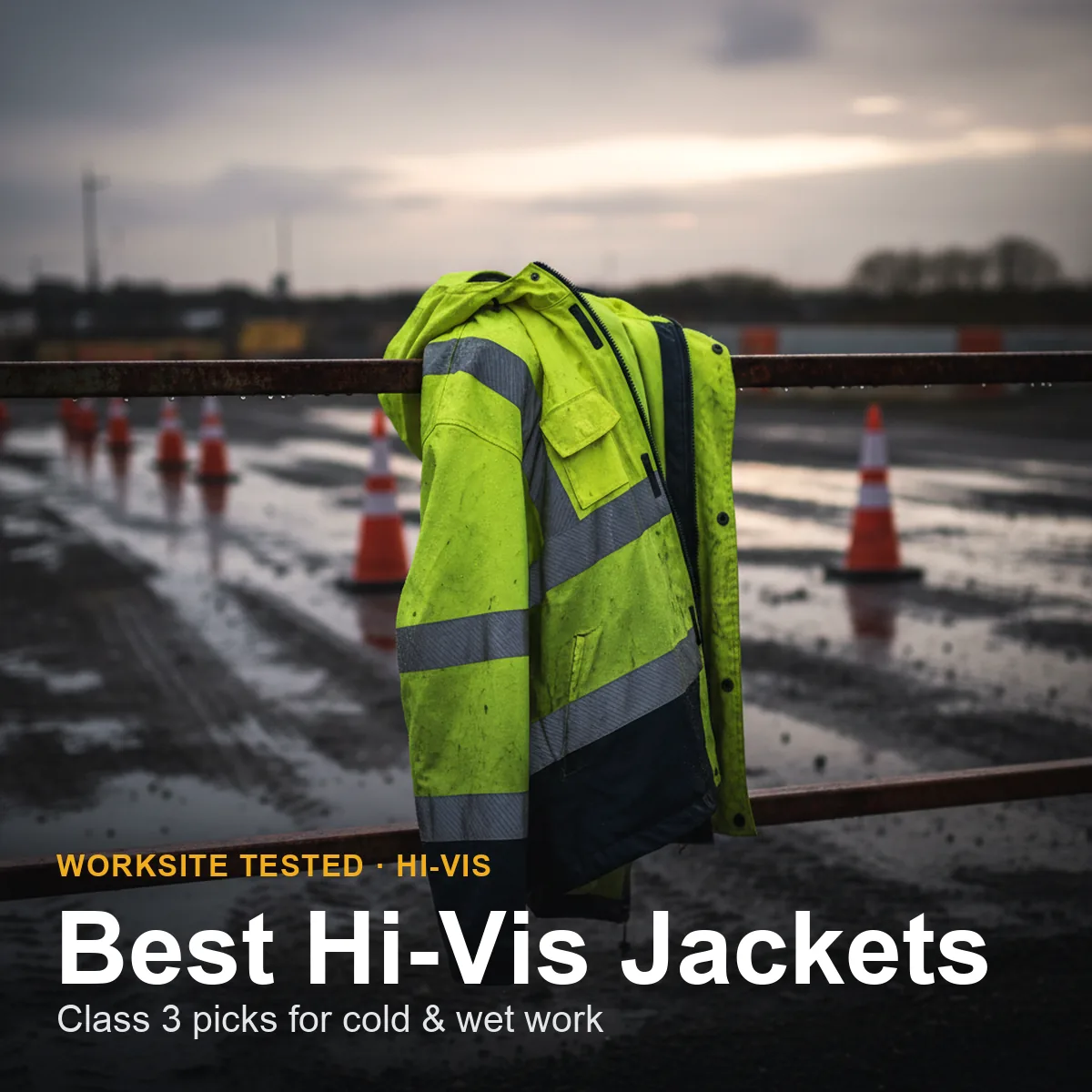
Short answer: for cold, wet roadway work where you need the highest-visibility tier, get an insulated, waterproof ANSI/ISEA 107 Class 3 jacket. My all-around pick is the Tingley Icon LTE J27122 ($87.99) — a breathable, waterproof Type R Class 3 shell. If you need warmth, the Carhartt Sherwood 106694 ($179.99) is the insulated-and-dry pick, and the Tingley J26112 ($50.99) does insulated-and-waterproof on a budget. Every product in this guide was pulled live from Working Person's Store on June 28, 2026, confirmed in stock, with prices and specs read directly off each listing.
One rule I follow in a safety category: every number in here traces back to the actual listing or to a published standard I link. If the listing doesn't say it, I don't say it — and I'll tell you when a class is a manufacturer's stated compliance versus what the ANSI/ISEA 107 standard itself defines. I don't rank by commission. The $50 jacket and the $194 coat both get a fair shot at the right slot for your job.
Key Takeaways
- Class 3 is the highest-visibility tier. Under ANSI/ISEA 107, Class 3 requires a minimum of 1240 in² of fluorescent background material and 310 in² of retroreflective material (smallest size) — the most coverage in the standard, with sleeves. (gosafe.com; reflectiveapparel.com)
- Highway work means Class 2 or 3. The FHWA Worker Visibility Rule (23 CFR Part 634 / MUTCD) requires workers within the right-of-way of a Federal-aid highway who are exposed to traffic or construction equipment to wear ANSI/ISEA 107 Class 2 or Class 3 apparel. For high-speed traffic and low light, Class 3 is the standard choice. (gosafe.com; osha.gov)
- "Type R" is the one written into the highway rules. Two of these list Type R explicitly (Carhartt 106693, Tingley J27122) — Type R is the type required to meet MUTCD requirements in roadway traffic control zones. Where the listing states only "Class 3" without a Type, confirm the Type before relying on it for MUTCD compliance.
- Waterproof wording differs. The Tingley and Carhartt shells are described as "waterproof" / "100% waterproof" with taped or sealed seams; the Radians RW30 is described as "water-resistant." That's a real distinction for sustained-downpour work — see the table.
- Insulated vs shell. Three picks are insulated (Carhartt 106694 Sherwood, Tingley J26112, Radians SJ12 bomber). Four are shells (Carhartt 106693, Tingley J27122, Tingley C44122 FR coat, Radians RW30). Match the layer to the temperature.
- One FR option. Only the Tingley Eclipse C44122 carries arc-flash/FR ratings (listing cites NFPA 70E, CAL 8+ / CAT 2) alongside Class 3 — buy it only if your job has flame/arc hazards.
- Read the standard first: ANSI/ISEA 107 explained — Class 1, 2 & 3 and Type O/R/P. More hi-vis buying guides: all hi-vis jacket & vest guides.
What ANSI/ISEA 107 Class 3 actually means
Hi-vis apparel is graded by ANSI/ISEA 107, which sets three Performance Classes based on how much high-visibility material the garment carries. (For the full breakdown, see our ANSI/ISEA 107 explainer.) A compliant garment has to perform two ways: during the day through its fluorescent background fabric, and at night through its retroreflective trim — the silver tape that uses glass beads or prismatic elements to bounce light (like headlights) back toward its source. (Source: reflectiveapparel.com.)
Here are the published minimum material areas for each class, for the smallest garment size, confirmed across two independent sources:
- Class 1: minimum 217 in² of fluorescent background material and 155 in² of retroreflective material — the lowest level, for low-traffic / off-road environments.
- Class 2: minimum 775 in² of background and 201 in² of retroreflective material — for moderate-risk work near vehicle traffic.
- Class 3: minimum 1240 in² of background and 310 in² of retroreflective material — the highest coverage in the standard, for highest-risk, high-speed-traffic and low-light work. Every jacket in this guide is rated Class 3.
(Sources: gosafe.com; reflectiveapparel.com.)
Type O, Type R, and Type P
ANSI/ISEA 107 also defines three garment Types, which describe the work environment rather than the amount of material:
- Type O (Off-Road): for non-roadway environments where workers are not exposed to public roadway traffic or temporary traffic control (TTC) zones.
- Type R (Roadway): for environments with exposure to roadway traffic, right-of-ways, or TTC zones — available in Class 2 and Class 3. Type R is the type suitable to meet MUTCD regulatory requirements.
- Type P (Public Safety): for emergency/incident responders who need high visibility plus access to duty gear — available in Class 2 and Class 3.
One honest note on the sources: authorities agree that Type R and Type P garments span Class 2–3, but they differ on Type O. One explainer describes Type O as available in Class 1, 2, or 3; another treats it as effectively the Class 1 / off-road tier. For the jackets here, what matters is that Class 3 + Type R is the combination written into the highway rules. (Sources: gosafe.com; reflectiveapparel.com; worknmore.com.)
When the law requires hi-vis
For roadway work, the requirement is federal. The MUTCD / 23 CFR Part 634 (FHWA Worker Visibility Rule) requires that all workers within the right-of-way of a Federal-aid highway who are exposed to traffic or construction equipment within the work area wear high-visibility safety apparel meeting ANSI/ISEA 107 Performance Class 2 or 3 (or an equivalent revision). FHWA's rule covers workers exposed either to traffic — vehicles using the highway for travel — or to construction equipment within the work area. (Sources: gosafe.com; osha.gov.)
OSHA backs this up through the General Duty Clause — Section 5(a)(1) of the OSH Act — which requires employers to provide a workplace free from recognized hazards likely to cause death or serious physical harm. OSHA states that high-visibility apparel is required under the General Duty Clause to protect employees exposed to being struck by public and construction traffic in highway/road construction work zones, and points to FHWA's mandatory standard as evidence that struck-by hazards in those zones are well recognized by the industry. (Source: osha.gov.)
All 7 hi-vis jackets at a glance
| Jacket | Shell / Insulated | Class / Type (per listing) | Weather protection (per listing) | Best for | Price |
|---|---|---|---|---|---|
| Tingley Icon LTE J27122 | Shell | Class 3 Type R | Waterproof, breathable (ASTM E96), taped/sealed seams | Best all-around waterproof Class 3 shell | $87.99 |
| Carhartt Sherwood 106694 | Insulated | Class 3, Level 2 (ISEA 107-2015) | Waterproof membrane, full-taped seams, DWR | Warm + dry cold-rain pick | $179.99 |
| Tingley J26112 | Insulated | Class 3 (Type not stated) | 100% waterproof | Best budget insulated + waterproof | $50.99 |
| Carhartt Storm Defender 106693 | Shell | Class 3 Type R | Storm Defender waterproof, fully-taped seams | Type R shell for cool wet weather | $149.99 |
| Radians SJ12 bomber | Insulated (160 g liner) | Class 3 (Type not stated) | PU-coated weatherproof oxford | Mobile insulated bomber, cold dry-to-damp | $90.00 |
| Radians RW30 | Shell | Class 3 (Type not stated) | Water-resistant, PU-coated oxford | General-purpose Class 3 rain jacket | $84.99 |
| Tingley Eclipse C44122 FR coat | Shell (48" coat) | Class 3 + FR (NFPA 70E, CAL 8+ / CAT 2) | 100% liquid-proof PVC, taped | Arc-flash / FR + waterproof + Class 3 | $194.99 |
1. Tingley Icon LTE J27122 — best all-around waterproof Class 3 shell
On a wet roadway crew, the jacket I'd reach for first is the Icon LTE. It is the rare rain shell that takes breathability seriously: the listing describes PU-on-75-denier-ripstop construction with stitched, taped, and sealed seams, plus breathability tested to ASTM E96. That second part is what keeps you from sweating through your own jacket on a long shift — a sealed waterproof shell that can't vent turns into a sauna. It is listed as ANSI/ISEA 107 Type R Class 3, which is the rating you want for traffic-control-zone work. Six pockets including a dedicated radio pocket, a two-way zipper, and a roll-away hood round it out. As an uninsulated shell it is best in mild-to-cool wet weather or layered over a sweatshirt when it's cold.
- Pros: Type R Class 3 (the highway-rule type); waterproof with taped/sealed seams; breathability cited to ASTM E96; six pockets + radio pocket; sizes through 5XL.
- Cons: No insulation — you layer for cold; hi-vis yellow shows grime.
Check price at Working Person's Store
2. Carhartt Sherwood 106694 — best warm-and-dry cold-rain jacket
When it's genuinely cold and wet — winter shoulder work, overnight paving, standing flagging in a downpour — you want insulation and a waterproof membrane in the same jacket, and that's the Sherwood. The listing describes a 250-denier polyester shell with Rain Defender DWR, a waterproof membrane with full-taped seams, and a quilted brushed-polyester insulated lining, with 3M Scotchlite segmented reflective trim. Read the visibility line carefully: the listing states ANSI Class 3, Level 2 visibility and references the ISEA 107-2015 edition (an earlier revision of the standard). The pocket layout is genuinely useful — a chest map pocket with a waterproof zipper, a left sleeve pocket, two utility bands — and the snap-on quilt-lined hood seals up the package.
- Pros: Insulated + waterproof membrane with full-taped seams; 3M reflective trim; deep pocket set with a waterproof-zip map pocket; quilt-lined hood.
- Cons: Top of the price range; listing references the older ISEA 107-2015 edition and Class 3 "Level 2" — verify against your spec sheet if your job requires a current-edition garment.
Check price at Working Person's Store
3. Tingley J26112 — best budget insulated + waterproof jacket
If you need warm and dry but the budget is tight, this is the value leader of the group. At $50.99 the J26112 is an insulated, quilt-lined, 100% waterproof Class 3 jacket — that's a combination you usually pay a lot more for. The 210-denier shell, quilted body-and-sleeve insulation, and 2-inch reflective bands for 360-degree visibility cover the basics, and the black interior and bottom hide the dirt that a head-to-toe yellow jacket never can. Eight pockets, two mic tabs, and elastic cuffs and waist make it a working cold-weather jacket. One thing to confirm before you buy: the listing rates it ANSI/ISEA 107 Class 3 but does not specify a Type. If your job requires a documented Type R garment for MUTCD compliance, check that with the manufacturer first.
- Pros: Insulated + 100% waterproof at $50.99; eight pockets + two mic tabs; black trim hides grime; sizes S–5XL.
- Cons: Listing states Class 3 but no Type — verify Type R if you need MUTCD documentation.
Check price at Working Person's Store
4. Carhartt Storm Defender 106693 — best Type R shell for cool, wet weather
This is the explicitly Type R Class 3 shell in the group, and it's the one I'd point a roadway crew toward when they don't need insulation. The listing describes a 100% polyester three-layer twill (5.25 oz) with Storm Defender waterproof technology and fully-taped seams, and 3M Scotchlite segmented reflective material rated to maintain performance through 75 home launderings — a real durability number on a jacket that gets washed hard. It meets the ANSI/ISEA 107 standard and the ANSI Class 3 Type R visibility standard per the listing. The loose midweight fit gives you room to layer a hoodie underneath when the temperature drops, and a full-length waterproof zipper with storm flap keeps the wind out.
- Pros: Explicit Type R Class 3; waterproof with fully-taped seams; reflective trim rated to 75 launderings; loose fit for layering.
- Cons: Uninsulated — a layering shell, not a cold-weather jacket; only two outer + two interior pockets.
Check price at Working Person's Store
5. Radians SJ12 bomber — best mobile insulated jacket for cold dry-to-damp work
Not every cold-weather job is a downpour. For cold dry-to-damp work where you're moving — climbing, bending, in and out of a cab — a long coat fights you. The SJ12 bomber cut, with a 160-gram quilted liner over a PU-coated weatherproof 300-denier oxford shell, gives you insulation in a shorter, more mobile package. The listing states a Class 3 visibility rating and that it meets ANSI-ISEA Class 3 standards. A 3D flap-covered chest pocket sized for a phone or radio and a concealed detachable hood are the practical touches. The listing carries a 4.7/5 store rating across 7 reviews — that's the retailer's customer rating, a real but small signal, and not our editorial score.
- Pros: Insulated 160 g liner in a mobile bomber cut; weatherproof PU-coated oxford; flap-covered phone/radio chest pocket; concealed detachable hood.
- Cons: Listing states Class 3 but no Type; "weatherproof," not stated 100% waterproof — treat as damp/showery rather than sustained downpour.
Check price at Working Person's Store
6. Radians RW30 — best general-purpose Class 3 rain jacket
The RW30 is the everyday-wet-weather Class 3 jacket, and it has two features I rarely see at $84.99: a D-ring pass-through for clipping in a radio or badge, and mic tabs on both shoulders. The 300-denier PU-coated hi-vis oxford with Reflectivz tech, a vented cape back for airflow, two-inch reflective tape (one horizontal, two vertical, two sleeve stripes), and a detachable hood make it a complete crew jacket. One honest distinction: the listing describes this as "water-resistant," not the "waterproof" or "100% waterproof" wording the Tingley shells use. For showers and general wet site work it's fine; for a sustained downpour I'd step up to a stated-waterproof shell. Unisex sizing makes it easy to outfit a mixed crew.
- Pros: D-ring pass-through + dual mic tabs; vented cape back; four pockets incl. radio pocket; unisex sizing through 5XL; lowest price in the group.
- Cons: Listing says "water-resistant," not waterproof — not for sustained heavy rain; Type not stated.
Check price at Working Person's Store
7. Tingley Eclipse C44122 — best FR + waterproof Class 3 coat
This one is a specialty pick — don't buy it unless you actually need the FR side. The Eclipse is a 48-inch full-length coat carrying tri-hazard protection: ANSI/ISEA 107 Class 3 visibility, 100% liquid-proof PVC coating, and arc-flash/flame-resistant protection (the listing cites NFPA 70E, CAL 8+ / CAT 2, and ASTM). For electrical utility crews who stand in the rain and also work around arc-flash hazards, that combination closes a gap most hi-vis rainwear leaves open — standard rain coats are not arc-rated. A flame-resistant corduroy collar, Thermo-grid heat blocking, a fully vented cape back, and an oversized 3-piece hood with hook-and-loop take-up straps round it out. At $194.99 it's the top of the range, but FR-rated waterproof Class 3 is a small, expensive category and this is a legitimate entry.
- Pros: Class 3 + FR/arc (NFPA 70E, CAL 8+ / CAT 2 per listing) + 100% liquid-proof PVC in one coat; FR collar; full-length coverage; vented cape back.
- Cons: Most expensive; PVC coat is heavy and warm — overkill unless you need the FR rating; sizes to 4XL only.
Check price at Working Person's Store
How to choose: shell vs insulated, waterproof vs water-resistant
Match the layer to the temperature. A shell (Tingley J27122, Carhartt 106693, Radians RW30, the FR coat) keeps rain out but adds little warmth — right for mild-to-cool wet weather or layering. An insulated jacket (Carhartt Sherwood 106694, Tingley J26112, Radians SJ12 bomber) builds the warmth in for cold work. Buying an insulated jacket for summer rain just cooks you; buying a shell for January flagging leaves you cold.
Read the waterproofing wording on the listing. "Waterproof" / "100% waterproof" with taped or sealed seams (the Tingley and Carhartt shells) is built to keep out a sustained downpour. "Water-resistant" (the Radians RW30) handles showers and general wet weather but isn't rated for prolonged heavy rain. "Weatherproof" (the Radians SJ12) sits in between. It's a real distinction worth matching to how wet your work actually gets.
Confirm the Type if the job is on a public road. Type R is the type written into the MUTCD highway rules. Two picks list Type R explicitly (Carhartt 106693, Tingley J27122); the others list Class 3 without stating a Type. That doesn't make them non-compliant garments, but if your job requires documented Type R apparel for a Federal-aid highway right-of-way, verify the Type on the spec sheet before you rely on it.
Frequently Asked Questions
What ANSI class do I need for highway and roadway work?
Workers within the right-of-way of a Federal-aid highway who are exposed to traffic or construction equipment must wear ANSI/ISEA 107 Performance Class 2 or Class 3 apparel under the FHWA Worker Visibility Rule (23 CFR Part 634 / MUTCD). Class 3 is the standard choice for high-speed traffic and low-light or nighttime work because it carries the most high-visibility material in the standard. (Sources: gosafe.com; osha.gov interpretation 2009-08-05.)
What's the difference between ANSI Class 2 and Class 3?
The classes differ by required material area. Class 2 requires a minimum of 775 in² of fluorescent background and 201 in² of retroreflective material; Class 3 requires 1240 in² background and 310 in² retroreflective (smallest size). Class 3 garments have sleeves and more coverage, making them the highest-visibility tier for high-speed or nighttime exposure. (Sources: gosafe.com; reflectiveapparel.com.)
Is a Class 3 rain jacket enough on its own, or do I need pants too?
A Class 3 hi-vis jacket meets Class 3 on its own. Hi-vis rain pants and bibs aren't separately rated as a standalone class, but when worn with a Class 2 or 3 top they can form a higher-coverage ensemble. For wet roadway work, pairing a Class 3 jacket with hi-vis rain pants maximizes coverage. Confirm any ensemble-pairing details against the specific product listings before relying on them.
What does Type O, Type R, and Type P mean on hi-vis labels?
Type R (Roadway) is for workers exposed to roadway traffic, right-of-ways, or temporary traffic control zones, and is the type required to meet MUTCD highway rules (Class 2 or 3). Type P (Public Safety) is for emergency and incident responders (Class 2 or 3). Type O (Off-Road) is for workers not exposed to public roadway traffic. (Sources: gosafe.com; reflectiveapparel.com; worknmore.com.)
Do I need an FR (flame-resistant) hi-vis jacket?
Only if your job has arc-flash or flame hazards, like electrical utility work. FR hi-vis options such as the Tingley Eclipse C44122 carry both ANSI/ISEA 107 Class 3 and FR/arc ratings (the listing cites NFPA 70E, CAL 8+ / CAT 2, and ASTM). For general roadway and construction work without flame exposure, a standard Class 3 waterproof jacket is sufficient and far cheaper. (Source: workingperson.com Tingley C44122 listing.)
What's the warmest Class 3 jacket for cold, wet work?
For cold and wet conditions, look for an insulated, waterproof Class 3 jacket. On Working Person's Store, the insulated and quilt-lined waterproof options here include the Carhartt Sherwood 106694 and the Tingley J26112, plus the 160-gram-lined Radians SJ12 bomber for mobile cold-but-damp work. Insulated waterproof shells keep you warm and dry while holding Class 3 visibility. (Source: workingperson.com product listings.)
Why Trust This Guide
This guide is written and reviewed by Marco Reyes, an independent work-safety-gear reviewer. Every recommendation is built on the published standards (ASTM F2413 for footwear, ANSI Z359 for fall protection, ANSI/ISEA 107 for hi-vis, the OSHA rules), manufacturer spec sheets and product labels, hands-on handling, and what tradespeople actually report — and we tell you when a number is a manufacturer claim versus an independent standard, and when a jacket is rated for one hazard but not another. Every product here was pulled live from Working Person's Store on June 28, 2026, confirmed in stock, with prices and specs verified against the listing — no numbers were inferred, extrapolated, or borrowed from other models. We earn an affiliate commission if you buy through some of our links, at no extra cost to you, and we never rank by commission over safety — see our affiliate disclosure.