
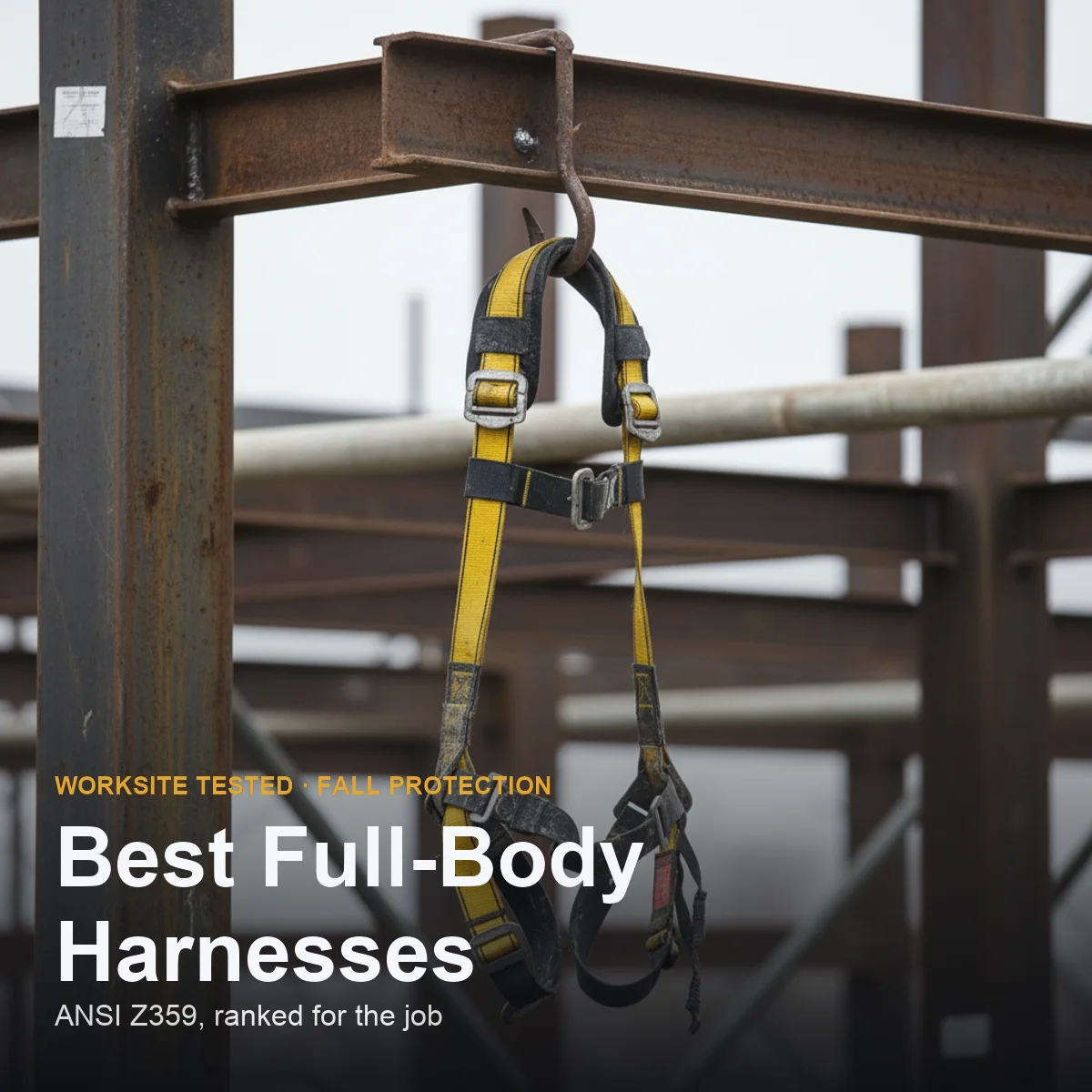
A full-body harness is not the piece of gear you buy cheap and hope for the best. Under OSHA 29 CFR 1926.501(b), any unprotected edge or side 6 feet or more above a lower level in construction requires fall protection — and on most job sites, a personal fall arrest system means a harness. In general industry under 29 CFR 1910.28, that trigger drops to 4 feet. The harness is the last line between a worker and the ground. I have ranked six real harnesses here — from a $49 no-frills contractor unit to a $633 suspension-trauma-aware construction harness — based on what they actually claim, not what their marketing suggests.
Key Takeaways
- ANSI and OSHA weight ratings are not the same number. The ANSI Z359.11 user range cited on these listings is roughly 130–310 lb. Manufacturers often also print a higher OSHA user capacity on the same label — 400 to 425 lb on the harnesses in this guide. Both numbers can sit on the same label. They are not contradictory — OSHA and ANSI set different limits for different purposes.
- Check which Z359.11 revision year a listing cites. The harnesses here that name a year cite Z359.11-2014 (FallTech 7016, FallTech 7016B, MSA V-FORM); the rest state "ANSI Z359.11" without naming a revision year. The 2021 revision added requirements like a modified head-first dynamic test and updated frontal-connection stretch-out. Both 2014 and 2021 harnesses are valid on job sites today; check your site's inspection program for which revision it requires, and don't assume a listing meets 2021 unless it says so.
- A harness alone is not a fall arrest system. You need a compliant anchorage (5,000 lbs per attached employee under OSHA 1926.502(d)), a connecting subsystem (lanyard, SRL), and a rescue plan. The harness is one piece.
- Suspension trauma is real. A worker hanging motionless in a harness after a fall can lose consciousness in minutes from blood pooling in the legs. A suspension trauma strap or a SwitchPoint-style deployment system buys time. OSHA and NIOSH both document this risk.
- Working Person's Store (workingperson.com) does not carry fall-protection harnesses — their catalog focuses on boots, hi-vis, and workwear. Every harness in this guide is sourced from a dedicated safety/PPE retailer. Links go to those live listings.
What the standards actually mean — plain terms
OSHA fall-protection trigger heights
Construction (29 CFR 1926.501): 6 feet above a lower level. This is the standard most residential and commercial construction crews work under. The three accepted protection methods are guardrail systems, safety net systems, or personal fall arrest systems (PFAS). A full-body harness is part of a PFAS. Source: osha.gov/laws-regs/regulations/standardnumber/1926/1926.501.
General industry (29 CFR 1910.28): 4 feet above a lower level. Updated in 2017. Acceptable methods include guardrail systems, safety net systems, and personal fall protection systems. Source: osha.gov/laws-regs/regulations/standardnumber/1910/1910.28.
What OSHA requires of a personal fall arrest system
Under 29 CFR 1926.502(d), a personal fall arrest system must limit maximum arresting force to 1,800 pounds on the worker; limit free fall to no more than 6 feet; be rigged so the worker cannot contact a lower level; and anchor to a point capable of supporting at least 5,000 pounds per attached employee. That 5,000 lb figure is for the anchorage — not the harness D-ring, which has its own rating. Source: osha.gov/etools/construction/falls/arrest-systems.
ANSI Z359 — what it is and what it is not
ANSI/ASSP Z359 is a family of standards maintained by the American Society of Safety Professionals, not a single document. Key substandards: Z359.11 covers full-body harnesses; Z359.14 covers self-retracting devices. A harness labeled "ANSI Z359.11" has been designed to meet that specific substandard — it says nothing about whether the anchorage or lanyard is compliant. Source: assp.org.
ANSI Z359.11 user range: 130–310 lbs. That is the range cited as the ANSI user capacity on the harness listings in this guide (the FallTech 7016 and MSA V-FORM both print "130–310 lb max" / "133–310 lb max" as the ANSI capacity). Some manufacturers rate the same harness to a higher capacity (400–425 lbs) under OSHA standards — the FallTech 7016 and 7016B listings, for example, state an OSHA user capacity of 130–425 lb alongside the lower ANSI range. If you see both numbers on a label, that is correct — they reflect two different standards, not a conflict.
What the 2021 revision changed: the Z359.11-2021 update added a modified, head-first dynamic test procedure and new stretch-out requirements for frontal connections, among other revisions. ASSP describes the changes in general terms; the specific quantitative strength values (webbing breaking strength, attachment-point load figures) live in the purchased ANSI/ASSP Z359.11-2021 document itself, so I won't quote pound numbers I can't source from a public listing. Source: ASSP article on the updated Z359.11 standard.
What a full-body harness is, per ANSI Z359.11: "a body support designed to contain the torso and distribute the fall arrest forces over at least the upper thighs, pelvis, chest and shoulders." That definition matters because a chest harness or body belt alone does not qualify as a full-body harness for fall arrest under OSHA.
Six harnesses compared
| Harness | ANSI standard cited | D-rings | ANSI capacity | OSHA capacity | Price |
|---|---|---|---|---|---|
| FallTech 7016 | Z359.11-2014 | 1 dorsal | 130–310 lb | 130–425 lb | $49–$54 |
| FallTech 7016B | Z359.11-2014 | 1 dorsal | 130–310 lb | 130–425 lb | $82.74 |
| MSA V-FORM (10196642) | Z359.11-2014 | 1 dorsal | 133–310 lb | 400 lb max | $107.99 |
| Miller DuraFlex (E650QC-7) | Z359.11 (revision not specified on listing) | Dorsal + 2 side | not stated | 400 lb (listing states) | $260–$388 |
| Werner ProForm SwitchPoint H06314X | Z359.11 (revision not specified on listing) | Dorsal + hip + side | not stated on listing | not stated on listing | $633 |
| 3M DBI-SALA ExoFit X100 | Z359.11 (revision not specified on listing) | Dorsal (SRL adapter) + 2 side positioning | not stated | 420 lb max | $598 |
Note on weight capacity: The ANSI Z359.11 user range (130–310 lb) and the OSHA-rated capacity are different numbers from different standards. "Not stated on listing" means I will not infer a number that is not printed on the source listing.
1. FallTech 7016B Contractor+ — best value step-up
The 7016B is what I would put on a crew member who has been wearing the bare-minimum harness and complaining about shoulder soreness by noon. The padded mesh shoulder yoke is a real difference — not luxury padding, just the kind of cushion that keeps you from shrugging your gear off in the afternoon when you are tired. The proprietary dorsal attachment sleeve for personal SRLs is a clean engineering decision: it keeps the SRL's connection aligned properly at the back ring instead of letting it drift sideways.
On standards, the Mega Depot listing cites ANSI Z359.11-2014 — the same revision as the budget 7016, not the 2021 update. Where it does add detail is capacity: the listing prints an OSHA user capacity of 130–425 lb alongside the 130–310 lb ANSI range. If your inspection program specifically requires the 2021 revision, neither FallTech in this guide is a guaranteed match on that point — verify against current FallTech product documentation.
- Pros: Padded mesh shoulder yoke; SRL attachment sleeve; OSHA user capacity 130–425 lb stated; two size groups (S/M/L and XL/2X).
- Cons: Cites Z359.11-2014, not the 2021 revision; made-to-order at Mega Depot — 1–2 week lead time, $100 minimum FallTech order.
Check FallTech 7016B at Mega Depot →
2. FallTech 7016 Contractor — best budget pick for crews
Forty-nine dollars. That is the entry price for a harness that cites ANSI Z359.11-2014, OSHA 1926.502, and CSA Z259.10-2018, with polyester webbing rated to 5,000 lb minimum static strength and an alloy steel dorsal D-ring at the same rating. On a crew that might go through harnesses due to damage, replacement, or theft, the cost arithmetic is real.
The tongue-buckle leg closures with 9 grommeted positions give you actual fit adjustment. If you have tried fitting a one-size harness on a wide crew, you know why this matters. The 7016 comes in four size groups including an XS and a 3X — wider size coverage than most harnesses at this price.
The honest caveat: this cites Z359.11-2014, not the 2021 revision. (Note that the step-up 7016B listing also cites 2014 — so don't reach for it expecting a newer standard year; reach for it for the padding and SRL sleeve.) If your inspection program or site safety plan specifically requires the 2021 standard, verify current compliance with FallTech before relying on either listing. If not, the 7016 is a legitimate, tested harness at an honest price.
- Pros: $49–$54 per unit; 4 size groups including XS and 3X; 5,000 lb polyester webbing and D-ring; in stock at multiple retailers; ANSI Z359.11-2014 and OSHA 1926.502 compliance stated.
- Cons: Cites Z359.11-2014, not 2021; no padding; no SRL attachment features.
Check FallTech 7016 at The Power Tool Store →
3. MSA V-FORM (10196642) — mid-tier with fast buckle
The MSA V-FORM sits at $107.99 for the standard 1D non-belted version and brings a few things the FallTech budget units don't: the RaceFORM chest buckle (patent-pending) is designed for fast one-handed connection, and RFID tagging is built in for inspection programs that scan gear rather than mark it with a marker. MSA has a long reputation in mining and industrial safety — this is not an off-brand harness.
The listing cites ANSI Z359.11-2014 (same revision caveat as the FallTech 7016). The shipping lead time at US Cargo Control is 10–14 business days — plan ahead. If your work requires positioning, the 10197364 variant adds hip D-rings and shoulder padding at around $199, but that is a separate SKU and a different configuration.
- Pros: Fast RaceFORM chest buckle; RFID for inspection; OSHA capacity 400 lb stated; MSA brand reputation; 3.15 lb product weight.
- Cons: Cites Z359.11-2014; 10–14 business day shipping at US Cargo Control; no padding or SRL features on the base 10196642 SKU.
Check MSA V-FORM at US Cargo Control →
Miller DuraFlex Ultra (E650QC-7/UGN) — best for high-movement jobs
The DuraFlex webbing is the defining feature here. Standard polyester webbing is stiff, especially in the cold. The elastomer webbing in the Miller E650QC-7 stretches as you move — bend over to pick up material, climb a ladder, reach overhead to connect rebar. After a few hours in a traditional harness, that stretch versus no-stretch difference accumulates as fatigue at the shoulder and leg straps.
The sub-pelvic strap is a meaningful add. If a fall does happen, the weight distribution shifts away from pure leg-strap loading — this reduces the risk of blood flow restriction in the femoral region during suspension. The fall indicator flag tells your inspector the harness has experienced a fall arrest event and must be taken out of service.
The listing cites ANSI Z359.11 along with older standards (ANSI A10.32, Z359.1, CSA Z259.10-M90). If your program specifies the 2021 revision explicitly, verify current Honeywell product documentation before relying on this listing alone. Price spread is wide: $259.99 at TNA Safety vs. $387.64 at Net Zero Tools — check both before ordering.
- Pros: Elastomer stretch webbing reduces fatigue on long shifts; sub-pelvic strap for post-fall suspension; fall indicator flag; quick-connect dual-tab buckles; side D-rings included; universal sizing (L/XL).
- Cons: Universal size does not fit all body types as precisely as a sized harness; listing cites older standard revisions alongside Z359.11 — verify 2021 compliance with Honeywell separately; price varies $130+ between retailers.
Check Miller DuraFlex at Net Zero Tools →
Werner ProForm SwitchPoint H06314X — best for high-risk arrest scenarios
The SwitchPoint system is the reason to buy this harness. After a fall arrest, a worker hanging in suspension faces suspension trauma risk — blood pools in the legs, and a healthy person can lose consciousness in under 15 minutes. On a job site where rescue is fast, this is manageable. On a site where access is difficult or a rescue could take longer, it is a documented hazard.
The SwitchPoint deployment cord, when pulled post-fall, redistributes the worker's weight into a seated position. That reduces the orthostatic stress on the circulatory system while awaiting rescue. That is not marketing language — it is the engineering rationale for a real physiological problem. OSHA's construction eTool specifically calls out the need for prompt rescue after fall arrest precisely because of suspension trauma risk.
The hardware is solid: aluminum cam torso adjusters, quick-connect buckles with a green engagement indicator (you can see from a distance whether it is properly seated), and moisture-wicking mesh lining. The listing's D-ring layout is back (dorsal), hip, and side — no chest D-ring (the City Ladder Co. spec table lists Chest: No) — which still gives you positioning capability at the hips for anchor-setting work. At $633, this is a professional ironworker or tower climber harness, not a budget option.
One honest note: user weight capacity was not confirmed verbatim from a Werner technical data sheet based on available listing information. The listing states ANSI Z359.11 and OSHA compliance without specifying a capacity number. Verify with Werner's product documentation for your site's requirements.
- Pros: SwitchPoint post-fall seated position deployment; green buckle engagement indicators; dorsal, hip, and side D-rings for positioning; moisture-wicking lining; sized S through XXL; SRL bumper.
- Cons: $633; user weight capacity not confirmed verbatim from listing — verify with Werner; revision year of Z359.11 not specified on listing.
Check Werner SwitchPoint H06314X at City Ladder Co. →
3M DBI-SALA ExoFit X100 — best all-in construction harness
This is the harness for ironworkers, steel erectors, and anyone on a job site where fall protection is the primary daily concern and comfort over a 10-hour shift matters. The integrated personal SRL adapter at the dorsal D-ring is the right design call — it eliminates the awkward hardware stacking that comes from clipping an SRL to a standard D-ring and keeps the connection geometry correct. The suspension trauma strap is included in the box, not an upsell.
The 3M Connected Safety RFID tag supports gear tracking and inspection programs without having to manually write on the harness. The removable back pad is a practical feature — you can pull it out in warm weather, put it back in cooler conditions. At 420 lbs OSHA-rated maximum work load (per the listing), this is one of the higher-rated harnesses in the guide for heavier workers.
At $598, it is not cheap. But it is priced against professional ironworker gear, not a roofing crew's budget option. If you are in the harness every day, the math on fatigue, fit, and integrated features changes.
- Pros: Integrated SRL adapter at dorsal ring; suspension trauma strap included; RFID tracking; removable comfort back pad; auto-resetting lanyard keepers; includes waist belt; 420 lb OSHA work load; usually ships 1–2 days.
- Cons: $598; listing does not specify Z359.11 revision year; no universal size option (sized S/M/L/XL only).
Check 3M DBI-SALA ExoFit X100 at Fall Protection Pros →
How I ranked these
Safety category, so the rule is simple: I only quote a spec the retailer listing actually states. When a listing doesn't name a standard revision year, I write "revision not specified." When a user capacity number isn't in the listing, I don't borrow one from a data sheet I didn't fetch. If a number isn't there, it doesn't go in the article.
I ranked primarily on real-job utility — what does this harness do better than the options below it for the tradespeople most likely to use it. Price factors in, but it doesn't override safety features. A $49 harness that meets the standard is a legitimate choice for the right crew; a $633 harness with suspension trauma engineering is a legitimate choice for a tower climber. Both can be correct.
No commission relationship affected this ranking. The MSA Workman harness (which references older standards ANSI A10.32 and Z359.1-2007 — not the current Z359.11-2021) was not included as a primary pick for that reason. It is a functional harness with a long market history, but the compliance citation on those retailer listings is behind current standards. Check it yourself at Select Safety Sales if the older standard meets your site's requirements.
What to look for before you buy
D-ring count and type
Most job sites requiring basic fall arrest need only a single dorsal (back) D-ring. If your work involves positioning — setting anchors, working at a fixed point, or any task where you need to lean into your harness as a support — you need hip D-rings. The Werner and 3M DBI-SALA in this guide both include hip and side rings; the FallTech and MSA V-FORM (base SKU) are dorsal-only.
Sizing is not optional
A harness that doesn't fit is a harness that doesn't perform correctly in a fall arrest. Tongue-buckle leg closures with grommeted positions (like the FallTech 7016) give you real adjustability across body types. Quick-connect buckles are faster to don but depend on the harness being sized to you before the buckle sets. If you're outfitting a crew, measure your people and match size ranges — don't assume universal fits everyone.
Suspension trauma
This is the part that rarely appears in harness marketing copy. After a fall arrest, a worker hanging in a harness with legs dangling can develop suspension trauma (orthostatic intolerance) — the harness straps restrict venous return from the legs, and the worker can lose consciousness in under 30 minutes. Rescue must be prompt. If your rescue plan can't guarantee fast access, a suspension trauma strap (Miller DuraFlex, 3M ExoFit) or a SwitchPoint deployment system (Werner) is worth the cost premium.
Inspection and retirement
Any harness that has arrested a fall must be taken out of service immediately and inspected before return to use — most manufacturers recommend retirement after a fall event. A fall indicator (the flag or tab that deploys during arrest) is a common feature on current ANSI Z359.11 harnesses, including the Miller DuraFlex in this guide. If a harness has no fall indicator and has been on a job site with multiple users, you may not know its history. RFID tagging (3M DBI-SALA, MSA V-FORM) supports documented inspection programs.