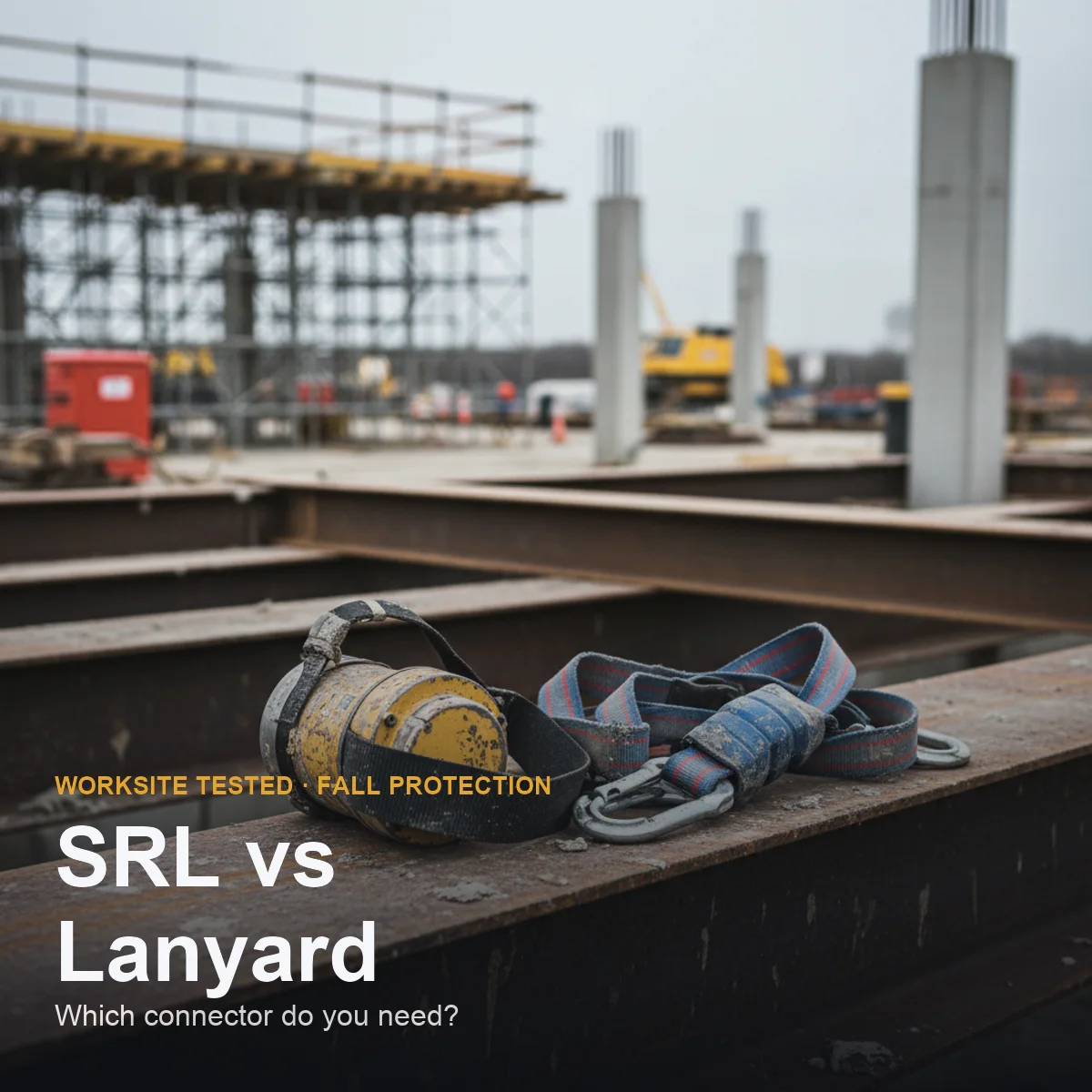
Short answer: if you have clearance and a solid overhead anchor, grab the shock-absorbing lanyard — it works and it's cheap. If clearance is tight, you're on a leading edge, or you need to move freely across a big deck, you need an SRL. The rest of this guide is the math behind that decision.
Bottom Line Up Front
- A 6 ft. shock-absorbing lanyard needs roughly 18.5 ft. of clearance between your anchor and the lower level to stop you before impact. Most residential roofs don't have that.
- A Class 1 SRL cuts that to roughly 12.25 ft anchor-to-lower-level — about a third less — and as little as ~6 ft measured from the working surface down. It starts arresting within inches, and the standard caps total arrest distance at 42 in (Source: standard — ANSI Z359.14-2021).
- Leading-edge work requires a Class 2 SRL. Standard lanyards and Class 1 SRLs are not rated for it.
- OSHA triggers at 6 ft. in construction, 4 ft. in general industry. Not 10. Not 8. Write it on your toolbox if you have to.
- Cheaper is sometimes fine. A $148 shock-absorbing lanyard on a 40 ft. steel erection job with clear overhead anchors is the right call. Don't spend $600 on an SRL because it sounds more serious.
What each one actually does
Shock-absorbing lanyard
It's a fixed-length web or rope connector — usually 6 ft. — with a shock pack stitched into the body. You fall the full lanyard length first. Then the shock pack deploys: internal stitching tears in a controlled way, converting kinetic energy into heat, slowing you down before the harness takes the load. The OSHA limit on arresting force is 1,800 lbs with a full-body harness (per 29 CFR 1926.502(d), fetched directly from osha.gov). The shock pack is designed to keep arrest force below that number. ANSI/ASSP Z359.13-2013 (Personal Energy Absorbers and Energy Absorbing Lanyards) sets the standard for how these devices are tested — for a 6 ft. free-fall lanyard, maximum deployment distance of 48 in. (4 ft.) and a user weight range of 130–310 lbs (Source: standard — ANSI/ASSP Z359.13-2013).
One-time use. If the shock pack deploys — even a little — the lanyard is done. The Miller Manyard HP has a warning flag that physically pops out when a fall occurs. That's your retire signal, not a suggestion.
Self-retracting lifeline (SRL)
A spring-loaded drum feeds cable or webbing out as you move and retracts the slack as you come back. The moment you fall, a centrifugal brake inside the housing locks. You're arrested within a foot or two of where you started falling — manufacturers and the standard put SRL free fall at less than 2 ft, often just inches, before the brake engages — not after dropping the full lanyard length. The standard caps total maximum arrest distance at 42 in for both Class 1 and Class 2 devices (Source: standard — ANSI Z359.14-2021). That short free fall is why the clearance math is so different.
SRLs come in two ANSI Z359.14-2021 classes:
- Class 1: Designed for overhead anchors. Maximum free fall of 2 ft. (610 mm) or less before arrest begins. Listing specs for the 3M Protecta Rebel 3590036 and Guardian CR5 both state Class 1 compliance.
- Class 2: Accommodates anchors from foot level up to 5 ft. below your dorsal D-ring. Permits up to 6 ft. of free fall. All leading-edge-rated SRLs are Class 2 — the cable or webbing must handle contact with a sharp edge during a fall. The 3M Protecta Rebel Leading Edge (model 3590047, $990.00 at Fall Protection Pros) is a Class 2 device listing ANSI Z359.14-2014 and Z359.14-2021 compliance, rated to 310 lbs, built for that application.
Note: the class system changed in 2021, and the old labels were about arrest distance, not anchor location. Before the 2021 revision, ANSI Z359.14 used Class A and Class B. Class A had a maximum arrest distance of 24 inches; Class B allowed a longer maximum arrest distance of 54 inches (Source: standard — per ANSI Z359.14, confirmed at guardianfall.com/srl-ansi-standard-faq and falltech.com). The 2021 revision retired the A/B labels entirely and replaced them with a single unified maximum arrest distance of 42 inches (1,067 mm) that applies to both Class 1 and Class 2 (Source: standard — ANSI/ASSP Z359.14-2021, per 3M and US Cargo Control). The new Class 1/Class 2 split is about anchor location and free fall (overhead vs. foot-level/leading-edge), not arrest distance. You may still see older listings referencing "Class A," "Class B," or Z359.14-2014; those aren't fake specs, just pre-2021 language. If your jobsite requires current-edition compliance, confirm the device meets Z359.14-2021 with the manufacturer.
The clearance math — this is the whole game
This is the number that makes the decision for you. Here's how both connectors stack up for a worker attached at the dorsal D-ring (between the shoulder blades), standing on the work surface, anchored directly overhead:
Apples-to-apples, both columns below use the same industry formula — required distance = free fall + deceleration distance + worker height (D-ring to feet, plus D-ring shift) + safety factor — measured from the anchorage down to the lower level, with the anchor directly overhead:
| Component | 6 ft. Shock-Absorbing Lanyard | Class 1 SRL |
|---|---|---|
| Free fall | 6 ft. (full connector length) | ~0.75 ft. (~9 in. before brake locks) |
| Deceleration / arrest distance | 3.5 ft. (OSHA 1926.502(d) cap) | 3.5 ft. (42 in. cap per ANSI Z359.14-2021) |
| Worker height (D-ring to feet) | 5 ft. | 5 ft. |
| D-ring shift after fall | 1 ft. | 1 ft. |
| Safety margin | 3 ft. | 2 ft. |
| Total clearance needed (anchor to lower level) | ~18.5 ft. | ~12.25 ft. |
Math check: lanyard column 6 + 3.5 + 5 + 1 + 3 = 18.5 ft. SRL column 0.75 + 3.5 + 5 + 1 + 2 = 12.25 ft. (Source: clearance methodology — constructionexec.com and 3M fall-clearance chart, multimedia.3m.com; caps per osha.gov 1926.502(d) and ANSI Z359.14-2021.)
A note on the two ways people quote SRL clearance: the ~12.25 ft. above is the honest anchor-to-lower-level number using the same accounting as the lanyard. You'll also see manufacturers quote a much smaller SRL minimum — roughly 6 ft. (free fall under 2 ft. + 3.5 ft. deceleration + a small safety factor) — but that figure is measured from the working surface down, not from the anchor, and it leaves out worker height (Source: standard methodology — pksafety.com / DBI-SALA). Both are correct; they just measure from different reference points. Don't compare a manufacturer's working-surface SRL number against a lanyard's anchor-to-ground number — that's the apples-to-oranges trap.
That 18.5 ft. lanyard number is not a typo. A standard 6 ft. shock-absorbing lanyard on a 15 ft. anchor height will put you into the ground. This is exactly why SRLs exist — same accounting, the SRL cuts the requirement by roughly a third (about 6 ft. less clearance) because the free-fall component drops from 6 ft. to under a foot.
If you're doing scaffold work on a 50 ft. structure with clear overhead tie-off and real anchor height above you, the math works fine for a lanyard. If you're on a low-slope roof, a mezzanine deck, or any structure under 20 ft. with the anchor at foot level, you need an SRL.
OSHA basics — the actual rules, not the marketing version
Two separate OSHA standards govern fall protection, and they set different trigger heights:
- Construction (29 CFR 1926.501): Protect workers from falls at 6 ft. or more above a lower level. This covers exposed edges, holes, formwork, scaffolding, roofing. (Source: osha.gov/laws-regs/regulations/standardnumber/1926/1926.501, fetched directly.)
- General industry (29 CFR 1910.28): The 2017 Walking-Working Surfaces final rule moved the trigger to 4 ft. or more above a lower level for most surfaces. Covers unprotected edges, hoist areas, runways, areas near dangerous equipment, and more. (Source: osha.gov/laws-regs/regulations/standardnumber/1910/1910.28, fetched directly.)
For personal fall arrest systems specifically, 1926.502(d) requires any system to: (1) limit free fall to 6 ft. maximum; (2) limit deceleration distance to 3.5 ft.; (3) limit arrest force to 1,800 lbs with a body harness. SRLs that limit free fall to 2 ft. or less must sustain 3,000 lbs static load; those permitting more than 2 ft. free fall must sustain 5,000 lbs. (Source: osha.gov/laws-regs/regulations/standardnumber/1926/1926.502, fetched directly.)
OSHA doesn't specify SRL vs. lanyard — it sets the performance limits. The ANSI Z359 family is the industry-consensus standard that tells you how devices are tested and classified to meet those limits. When a listing says "meets OSHA requirements," that's a manufacturer claim. When it says "ANSI Z359.14-2021 Class 1," that's a tested classification. Both matter; they're not the same thing.
When to use each
Use a shock-absorbing lanyard when:
- Your anchor is well overhead and you have confirmed clearance of at least 18–19 ft. to the lower level.
- You're working in a fixed position — boom lift, elevated platform, steel erection — not moving across a deck.
- Budget matters and the clearance math works. A good lanyard costs $100–$250. A comparable SRL runs $150–$600+.
- You need a double-leg (Y-lanyard) for 100% tie-off while changing anchor points. Most SRLs are single-leg.
Use an SRL when:
- Clearance is tight — rooftops, mezzanines, any structure under 20 ft. with overhead anchors, or any anchor that isn't well above your D-ring.
- You need to move freely. An SRL pays out and retracts as you walk the deck. A 6 ft. lanyard clips you to one anchor.
- You're on a leading edge (steel edge, floor opening, unfinished deck edge). Use a Class 2 leading-edge SRL only. Standard lanyards and Class 1 SRLs are not tested for sharp-edge contact during a fall.
- You're working at low heights with low anchors (Class 2 SRLs are designed for anchors at or below the D-ring level).
Product picks — verified specs, real prices
All three are real, currently listed products as fetched June 27, 2026. Prices can change.
Best value SRL for mobile deck work: Guardian CR5 6 ft. Class 1 SRL-P
At $156.97 (sale from $170.00 at Fall Protection Pros), this is the entry point for a legitimate Class 1 SRL and it's competitive with mid-range shock-absorbing lanyards. The SRL-P designation means it attaches at your dorsal D-ring — body-worn — not at a fixed overhead structural point. Six feet of polyester webbing, 420 lb max work load, 360-degree swivel top connection so you're not fighting twists as you move. The listing states ANSI Z359.14-2021 Class 1 compliance and OSHA 1910.140 and 1926.502 per the manufacturer page at guardianfall.com. Device weighs 3.26 lbs — you'll forget it's there by mid-morning. The QR-coded digital labels mean inspection records are tied to the unit, not a paper tag that wanders off.
What I'd grab this for: mobile work on a deck or flat roof where you need to cover ground and clearance is limited. At this price it's a legitimate SRL, not a budget compromise.
- Pros: Listing states ANSI Z359.14-2021 Class 1; $156.97; lightweight at 3.26 lbs; 360-degree swivel; SRL-P rated (dorsal D-ring attach); in stock.
- Cons: 6 ft. range limits reach — for wide decks you need a longer unit; webbing (not cable) is the lifeline, check for abrasion in your application.
Check price at Fall Protection Pros →
Best long-range SRL for structural steel: 3M Protecta Rebel 33 ft. Class 1 SRL
This is the step up when 6 ft. of reach isn't enough — 33 ft. of 3/16" galvanized steel wire rope in a stackable thermoplastic housing. The swiveling self-locking snap hook has an impact indicator so you know if it's taken a load. At $591.05 (listed sale from $820.90 at Durawear.com), it's a professional-grade unit for overhead anchor use on structural steel, bridge work, or any application where you need real cable range and the anchor is solidly overhead. Load capacity is 420 lbs. The listing states ANSI/ASSP Z359.14-2021 Class 1, OSHA 29 CFR 1926.502, and OSHA 29 CFR 1910.140. Built-in energy absorption means no separate shock pack to track. "Stackable" housing matters if you're running multiple units on a crew — they nest.
What I'd grab this for: 10-hour shift on an exposed structural steel deck or bridge where the anchor is overhead and I need 30+ ft. of cable range. The price is real money, but a galvanized steel SRL at this length from a name manufacturer is what the application calls for.
- Pros: Listing states ANSI/ASSP Z359.14-2021 Class 1; 33 ft. range; galvanized steel cable; 420 lb capacity; impact indicator; built-in energy absorber; stackable housing.
- Cons: $591.05 — significantly more than web SRLs; cable adds weight vs. webbing; this is Class 1 only (overhead anchors) — don't use it as a leading-edge solution.
Best shock-absorbing lanyard when clearance works: Miller Manyard HP 6 ft.
When the clearance math actually works in your favor, this is what I'd use. At $148.37 (Autumn Supply, 24 units in stock at time of fetch), the Manyard HP is a well-built, proven lanyard from Miller — a name that's been in fall protection for decades. Six-foot polyester web, 310 lb capacity, locking snap hooks at both ends. The heavy-duty tubular outer jacket serves as a backup web lanyard — a real redundancy feature, not marketing copy. The warning flag deploys visually if a fall occurs: you can see from 10 feet away that this lanyard needs to come out of service. The listing states it meets applicable ANSI and OSHA requirements — the retailer page does not specify which ANSI Z359 sub-standard or edition verbatim, so if your site requires explicit Z359 edition documentation, confirm that with Miller directly.
What I'd grab this for: aerial lift work, scaffold work, any fixed-position elevated task where my anchor is solidly overhead and I've confirmed at least 18–19 ft. of clearance below me. Don't reach for a $600 SRL when this does the job and the math supports it.
- Pros: $148.37; proven Miller construction; visual warning flag post-fall; backup outer jacket; locking snap hooks; simple and reliable.
- Cons: Needs ~18.5 ft. clearance — most tight applications it won't work; 310 lb limit (not 420 lb); retailer listing doesn't name a specific ANSI Z359 edition verbatim; single-use shock pack.
Check price at Autumn Supply →
Leading-edge work: a separate category
I want to call this out plainly because it's where jobsite injuries happen from equipment misuse. A leading edge is any exposed, unfinished edge where you could slide and the lifeline contacts the edge structure during a fall — open floor decking, unfinished concrete slab edges, steel beam flanges. Standard shock-absorbing lanyards are not rated for this. Class 1 SRLs are not rated for this. The cable or webbing of an unrated device can sever on a sharp edge before arrest is complete.
The device you need is a Class 2 leading-edge SRL. The 3M Protecta Rebel Leading Edge (model 3590047) is a real example: $990.00 at Fall Protection Pros, 33 ft. galvanized steel lifeline, 310 lb capacity, listing states ANSI Z359.14-2014 and Z359.14-2021 Class 2 compliance. It costs more because the testing requirements are more demanding — the device is tested for edge contact during the fall event itself. If your work is on a leading edge, this is not optional equipment; it's the right tool for the task.
Inspection and retirement — don't skip this
Fall protection equipment is single-use for arrest events. Any device that has arrested a fall must be removed from service. That's not a suggestion from a manufacturer trying to sell more gear — it's a physical reality. The shock pack in a lanyard is calibrated to deploy exactly once. An SRL brake that has locked under load may have altered internal tolerances. The Miller Manyard HP's warning flag and the 3M Protecta's impact indicator exist to make this decision obvious — not to give you a way to inspect and return to service.
Before each shift: inspect the full length of the lifeline or webbing for cuts, fraying, kinks, or chemical damage. Check the hooks for gate function — they should open smoothly and lock positively. SRL housing should have no cracks. Lanyards with any visible shock pack deployment (even partial tearing of the inner sleeve) are done. Document your inspections. OSHA expects a competent person to conduct pre-use inspection; it doesn't define a log format, but having a record is the smart move.
The call
Run the clearance math before you pick a connector. That number decides more than anything else on this list. If you have the clearance and a solid overhead anchor, the Miller Manyard HP at $148 is a legitimate, well-made choice — don't spend four times as much for the same job. If clearance is tight, you're mobile on a deck, or you're near any kind of edge, step up to an SRL. The Guardian CR5 at $157 gets you a real Class 1 unit for less than most people expect. And if you're on a leading edge, the Class 2 leading-edge SRL is the only answer — no substitutions.
Any questions about your specific anchor setup or clearance numbers, take them to a competent person on your site. The math in this guide is accurate to the standards cited, but your actual application has variables — anchor strength, harness fit, D-ring location — that need eyes on the job.
Frequently Asked Questions
How much fall clearance does a 6 ft. shock-absorbing lanyard need?
Roughly 18.5 ft. from the anchor down to the lower level: 6 ft. free fall (the full connector length) + 3.5 ft. deceleration + 5 ft. worker height + 1 ft. D-ring shift + 3 ft. safety margin. That's why a 6 ft. lanyard on a 15 ft. anchor height puts you into the ground. Most residential roofs don't have that clearance.
Why does an SRL need less clearance than a lanyard?
Because the free-fall component drops from 6 ft. to under a foot. An SRL's centrifugal brake locks within inches — the standard puts SRL free fall at less than 2 ft. — so the honest anchor-to-lower-level number for a Class 1 SRL comes out to about 12.25 ft., roughly a third less clearance than a lanyard. A lanyard makes you fall its full length first before the shock pack even deploys.
When should I use a lanyard instead of an SRL?
When your anchor is well overhead, you've confirmed at least 18–19 ft. of clearance to the lower level, and you're in a fixed position — boom lift, elevated platform, steel erection — not moving across a deck. If the clearance math works, a $148 shock-absorbing lanyard is the right call. Don't spend $600 on an SRL because it sounds more serious.
Can I use a Class 1 SRL or a standard lanyard on a leading edge?
No. Leading-edge work requires a Class 2 SRL. Standard shock-absorbing lanyards and Class 1 SRLs are not rated or tested for sharp-edge contact during a fall — the cable or webbing can sever on the edge before arrest is complete. On any exposed, unfinished edge, the Class 2 leading-edge SRL is the only answer, no substitutions.
At what height does OSHA require fall protection?
6 ft. or more above a lower level in construction (29 CFR 1926.501), and 4 ft. or more in general industry (29 CFR 1910.28, since the 2017 Walking-Working Surfaces rule). Not 10, not 8. For the arrest system itself, 1926.502(d) caps free fall at 6 ft., deceleration at 3.5 ft., and arrest force at 1,800 lbs with a full-body harness.