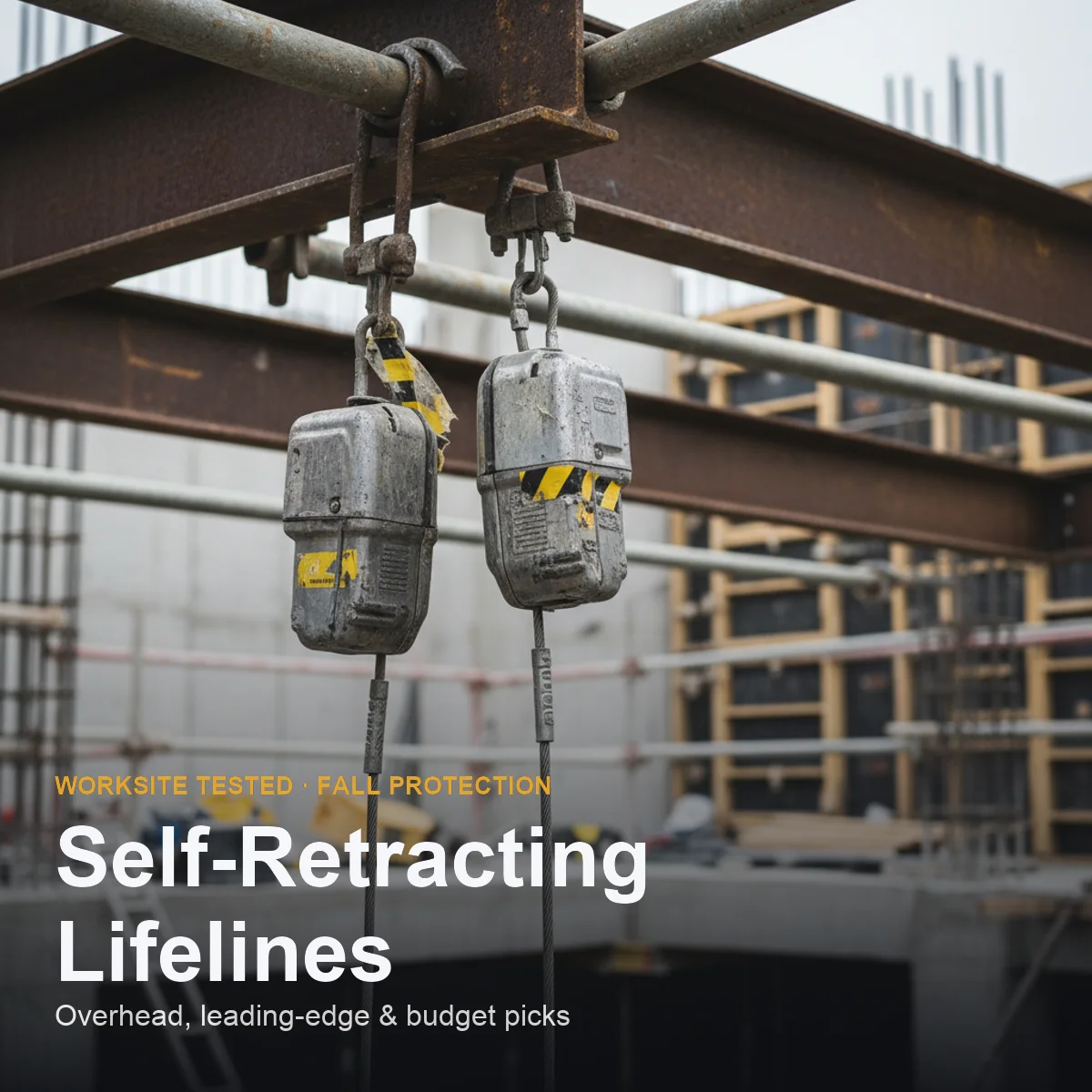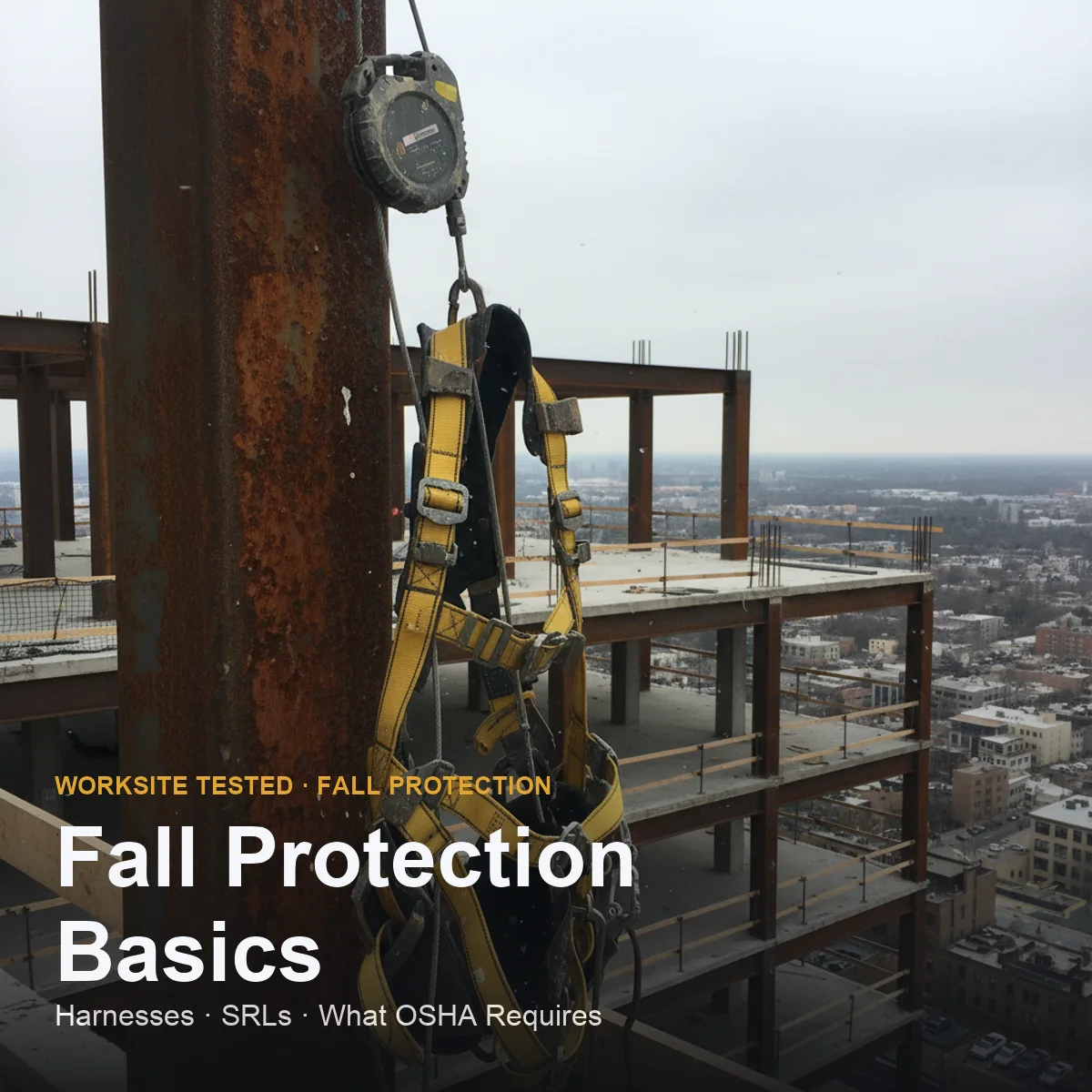
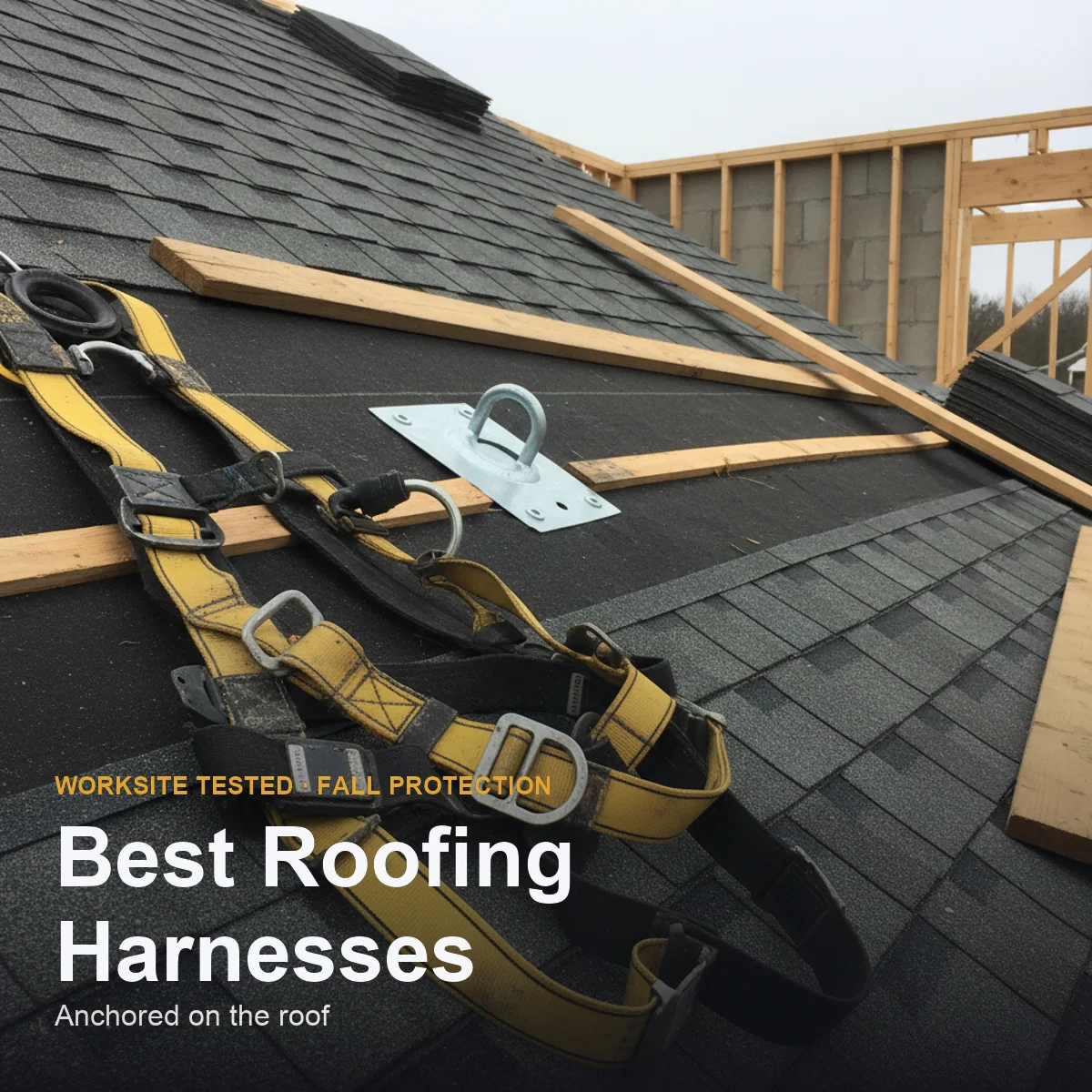
Falls kill more construction workers than anything else. In 2024, the Bureau of Labor Statistics recorded 389 fatal falls to a lower level in construction out of 1,034 total construction fatalities — Source: OSHA Stop Falls. Roofing is one of the riskiest categories. A system that rides in a truck for 6 months but fails on your first real fall is not fall protection. It is a false sense of security.
I looked at six real products — five complete kits and one standalone harness — all pulled from live retailer listings in June 2026. I will tell you the honest specs, flag what the listing says versus what the standard actually says, and point you to the cheapest legitimate source I found. I do not rank by commission. The $100 kit gets a fair shot against the $250 kit.
One rule that runs through this whole guide: if a number is not on the listing I reviewed, I do not write it. Standards language is attributed to the standard, not the product. "The listing states" means manufacturer assertion. "The standard requires" means the regulation or published standard. These are not the same thing and I will not blur them.
Key Takeaways
- OSHA requires fall protection at 6 feet on residential and steep roofs. Per 29 CFR 1926.501(b)(11), any employee on a steep roof (slope greater than 4-in-12 per 29 CFR 1926.500(b)) with unprotected edges 6 ft or more above a lower level must be protected by guardrail, safety net, or a personal fall arrest system. Source: 29 CFR 1926.501(b)(11).
- The anchor has to hold 5,000 lb. OSHA 29 CFR 1926.502(d)(15) requires anchorages capable of supporting at least 5,000 lb per attached employee, or a qualified person-designed system with a safety factor of at least two. Source: 29 CFR 1926.502(d)(15).
- Standard ANSI harness range is 130–310 lb. ANSI/ASSP Z359.11-2021 sets 130–310 lb (59–140 kg) as the standard user capacity range for full-body harnesses. Source: ANSI/ASSP Z359.11-2021. If you have workers outside that range, verify with the manufacturer.
- "OSHA and ANSI compliant" without a Z359.x number is a marketing statement, not a standard citation. The Werner kit is widely listed with that phrase. I could not find a specific Z359 standard number on any retailer page I reviewed. I will not assign one that is not on the listing.
- Fall clearance math must work. A standard 6-ft shock-absorbing lanyard system needs roughly 17–18 ft of clear space below your dorsal D-ring at the moment of arrest. If your roof edge is over a lower roof, a soffit, or a structure within that distance, the system may not stop you before contact. See the clearance table below.
All 6 picks at a glance
| Product | Type | Pieces | Weight capacity (listing) | Standards cited (listing) | Best for | Price (verified) |
|---|---|---|---|---|---|---|
| Werner K211201W UpGear | 3-piece kit | Harness + lifeline + anchor | Not published on listing | "OSHA and ANSI compliant" (no Z359.x number cited) | Budget residential, training crews | $109–$112 |
| Guardian 00815 Bucket of Safe-Tie | 5-piece kit | Harness + lifeline w/ integrated shock absorber + positioning device + anchor + bucket | 130–310 lb | OSHA 1910/1926, ANSI Z359.1-07, ANSI Z359.11-14 (kit); Z359.11-2021 (Velocity harness separately) | Best value complete kit | $124–$179 |
| FallTech 8595A Roofer's Kit | 5-piece kit | Harness + lifeline + shock lanyard + anchor + bucket | ANSI 130–310 lb; OSHA 130–425 lb (harness/anchor) | ANSI Z359.11-2014, ANSI Z359.15-2014, OSHA 1926.502, OSHA 1910.66 | Steep-pitch residential, best documented kit | $238–$258 |
| Malta Dynamics C7020-B2000 | 4-piece kit | Harness + lifeline assembly + anchor + bucket | 130–310 lb | ANSI Z359.11-2021, ANSI Z359.13-2013, OSHA 1926/1910 | Best price direct-buy kit | $100 direct / $139–$185 third-party |
| 3M PROTECTA 2199803 | 4-piece kit | Harness + lifeline + rope adjuster/lanyard + anchor + bucket | 310 lb (Grainger catalog cross-ref) | OSHA 1910.66, OSHA 1926.502 (kit listing); ANSI Z359.1 in related 3M documentation | Brand recognition for compliance documentation; lightest kit | $219–$258 |
| FallTech 7073 Harness | Standalone harness | Harness only (3 D-rings) | ANSI 130–310 lb; OSHA 130–425 lb | ANSI Z359.11-2014, OSHA 1926.502, OSHA 1910.140, CSA Z259.10-2018 | Best standalone harness to pair with existing anchor/lifeline | $124–$145 |
1. Werner K211201W UpGear — the $110 starter kit
Let me be straight about what this is. The Werner UpGear is a three-piece compliance kit aimed at residential contractors who need to be on a roof legally and affordably. For a solo roofer or a small crew doing residential work, $109–$112 for harness, lifeline, and anchor is hard to argue with.
Here is what I cannot tell you: the weight capacity. Neither panthereast.com nor McCoy's lists a weight capacity on the reviewed listing pages. That is a gap. If you have workers at the edges of the ANSI 130–310 lb range, call Werner before you hand this to them.
Also: the listing says "OSHA and ANSI compliant." I looked at both retailer pages. No specific ANSI Z359.x number appears. I will not invent one. This matters if your job superintendent or safety officer asks for a Z359 standard number for paperwork. The listing language may not satisfy that ask.
The color-coded (red/yellow/green) connection system is legitimately useful for training new hands — they can see at a glance which clip goes where. The 50 ft lifeline covers most residential pitches.
- Buy if: you need a legal, affordable entry-level kit for residential steep-slope work and your workers fall within a typical weight range.
- Skip if: you need a specific ANSI Z359.x number for documentation, or your workers are at the capacity limits and weight is not published.
Verified in stock: panthereast.com ($112.00) and McCoy's ($109.25, 11 units ship-to-store, estimated 07/11/2026 arrival). Source: panthereast.com and mccoys.com.
2. Guardian Fall Protection 00815 Bucket of Safe-Tie — best complete kit under $165
The integrated shock absorber is the design decision that separates this kit from the rest of the sub-$200 field. Most vertical lifeline setups use a separate rope grab and a separate shock-absorbing lanyard between the grab and your harness. The Guardian 00815 builds the shock pack into the lifeline assembly itself. One fewer connection point. One fewer thing to thread in the morning when it is cold and you are standing on a roof edge.
The Velocity harness is a real harness. It is sold separately and, per the Guardian product page, carries its own ANSI Z359.11-2021 rating. The 00815 kit-level listing (panthereast.com) cites ANSI Z359.11-14 — the older 2014 edition. I am using the kit-level citation for the kit, not swapping in the harness component's separate spec. That distinction matters when you fill out a safety data form.
The Temper Reusable Roof Anchor is zinc-plated steel with mounting hardware included. Reusable anchors matter on a multi-week job — you pull and reinstall, not buy a new one each time.
Price shopping matters here: hanessupply.com has it at $123.67. Panthereast has it at $164.99. Same product. Check both.
- Buy if: you want a complete 5-piece kit with a clean, fewer-connection lifeline design and a harness that stands on its own merits.
- Skip if: your workers are outside the 130–310 lb range, or your safety officer requires a specific newer Z359 standard number on the kit documentation.
Verified in stock at panthereast.com and hanessupply.com (June 2026). Source: panthereast.com ($164.99) | hanessupply.com ($123.67).
3. FallTech 8595A Roofer's Kit — mid-range, best documented
The FallTech 8595A is the pick if you do a lot of steep residential work and want an anchor that can handle it. The 7410 Hinged Reusable Wood Roof Anchor handles pitches up to 12/12, per the listing. The listing states a 5,000 lb minimum rating on the anchor — that number aligns with the OSHA 1926.502(d)(15) requirement of 5,000 lb per attached employee. I am stating the listing spec and the OSHA requirement separately because one is a manufacturer assertion and the other is a federal regulation. Both numbers happen to match. Source: 29 CFR 1926.502(d)(15) | uscargocontrol.com listing.
The kit also includes the FallTech 8368 ViewPack shock-absorbing lanyard — a 3 ft lanyard with an integrated rope adjuster. Short lanyard means less free fall in the event of an arrest. The 7016 harness is a single dorsal D-ring contractor build — straightforward, adjustable, no positioning D-rings. If you want hip D-rings, look at the standalone FallTech 7073 below.
The listing cites ANSI Z359.11-2014 and Z359.15-2014 — both are manufacturer/listing assertions. The dual ANSI citation is more documentation than the Werner or Malta kits provide, which matters for commercial sites with demanding safety officers.
- Buy if: you work on steep residential pitches and want an anchor with published specs and dual ANSI citations on the kit documentation.
- Skip if: budget is the primary concern. At $238–$258, you are paying for documentation quality and anchor capability — both are real, but cheaper kits can put you legally on a roof.
Ships free in 1–3 business days at uscargocontrol.com (verified June 2026). Source: uscargocontrol.com ($257.99) | standingseamroofanchor.com ($249.00) | fallprotectionpros.com ($237.97).
Check lowest price at Fall Protection Pros →
4. Malta Dynamics C7020-B2000 — the $100 kit that deserves a second look
$99.99 direct from Malta Dynamics. That is the lowest price in this roundup for a full kit with harness, lifeline assembly (including rope grab and shock pack), anchor, and bucket. The listing cites ANSI Z359.11-2021 for the harness — the current standard edition — and ANSI Z359.13-2013, ANSI Z359.1-2007, ANSI A10.32-2012, OSHA 1926, and OSHA 1910. All manufacturer/listing assertions. Source: maltadynamics.com.
I will tell you what I do not know: I have not put the Warthog harness through a 10-hour shift. The reviews at third-party retailers are mixed on comfort over a full day. At 20 lbs the kit is the heaviest in this group despite having four pieces instead of five. The rope grab shock pack is integrated into the 18" assembly — similar concept to the Guardian kit, which is a legitimate design advantage over setups that make you carry a separate lanyard.
The cheapest route is buying direct. Third-party retailers are at $139–$185 and some sizes are sold out. If maltadynamics.com shows it in stock at $99.99, buy it there.
- Buy if: budget is real and you want a complete kit with current ANSI Z359.11-2021 harness citation at the lowest price in this roundup.
- Skip if: you need the kit for a long-term daily-wear harness situation — the Warthog is functional but not the most comfortable option in this group for extended wear.
Available in stock on maltadynamics.com direct (verified June 2026). Source: maltadynamics.com ($99.99).
Check price at Malta Dynamics →
5. 3M PROTECTA 2199803 Compliance in a Can — lightest kit, brand recognition
13 lbs. That is the lightest complete kit in this group. Everything goes in the bucket, the bucket goes in the truck, and you are not carrying 20 lbs of safety gear up a ladder. 3M PROTECTA components are widely recognized by inspectors and safety officers — if your site has strict documentation requirements and the inspector knows the 3M PROTECTA line, this kit does not start a conversation. That is worth something on commercial residential projects with active oversight.
The compact rope adjuster with built-in 2 ft PRO shock-absorbing lanyard is a design I like. Short energy-absorbing connection. Made in USA — stated on the listing.
Two honest caveats. First: jendcosafety.com shows this kit as "not available for online purchase — call for availability." That is unusual and means you cannot just add to cart. Check walmart.com and saftgard.com for online purchase availability before banking on this kit being easy to source. Second: the kit listing at jendcosafety.com cites OSHA 1910.66 and OSHA 1926.502. ANSI Z359.1 compliance appears in related 3M documentation but is not prominently cited on the reviewed kit listing page. All claims are manufacturer/listing assertions. Weight capacity of 310 lb sourced from Grainger catalog cross-reference item 6ZLN1.
- Buy if: you want the lightest kit, Made in USA, with 3M PROTECTA brand recognition for compliance documentation.
- Skip if: you need to buy online quickly — availability at the primary source requires a phone call.
Source: jendcosafety.com ($218.94 sale / $257.58 regular — call for availability).
Check availability at Jendco Safety →
6. FallTech 7073 Contractor 3D Harness — the standalone harness pick
Most roundups ignore the standalone harness option. But a lot of experienced roofers already own an anchor and a lifeline they trust. If you need to replace a harness, or if your employer supplies the other components, the FallTech 7073 is the harness I would buy.
Three D-rings. Most harnesses give you one dorsal D-ring on the back. The 7073 adds two hip/side D-rings, which lets you clip in for positioning work — climbing a ladder, working a ridge, leaning into a valley — in ways a single-dorsal harness cannot. The waist pad (5-inch torso-sewn pad) matters at hour 7 of a 10-hour day. The air mesh shoulder yoke is not marketing — foam versus bare webbing at the shoulder contact point over a full shift is a tactile difference.
Listing states: static strength 3,600 lb min (per OSHA 29 CFR 1926.502(d)(4), D-rings must be proof-tested to 3,600 lb); webbing minimum 5,000 lb breaking strength. ANSI user capacity 130–310 lb; OSHA capacity 130–425 lb (two separate test protocols — do not conflate them). Source: falltech.com and 29 CFR 1926.502(d)(3)–(4).
Sizes 2X and 3X are available (models 70732X and 70733X). That matters for larger workers. The XL kit-included harnesses in the five kits above max out at L or L/XL.
- Buy if: you already have anchor and lifeline equipment and need a quality replacement harness, or need 3 D-rings for positioning work, or need sizes larger than L/XL.
- Skip if: you need a complete kit with anchor and lifeline — buy one of the kits above instead.
Available at falltech.com, ironworkergear.com, and safetysourcellc.com (verified June 2026). Source: ironworkergear.com ($145.00) | safetysourcellc.com ($123.57).
Check lowest price at Safety Source →
Fall clearance: the math that actually matters
The system works on paper. The question is whether there is enough empty space below you for it to finish working before you hit something. This is called fall clearance. You need to calculate it before you clip in — not after.
OSHA 29 CFR 1926.502(d)(16)(iii) requires that personal fall arrest systems be rigged so an employee can neither free fall more than 6 feet nor contact any lower level. That is the federal ceiling. The math below shows what that means in practice. Source: 29 CFR 1926.502(d)(16)(iii) and (iv).
| Component | Distance (ft) | Source |
|---|---|---|
| Lanyard length | 6.0 | OSHA 1926.502(d)(16)(iii) — max 6 ft free fall |
| Deceleration distance (max) | 3.5 | OSHA 1926.502(d)(16)(iv) — max 3.5 ft deceleration |
| Worker height from feet to dorsal D-ring (estimate) | 5.0 | Approximation; verify for individual worker |
| Harness elongation | 1.0 | Per fcsafety.com analysis of OSHA/ANSI parameters |
| Safety margin | 2.0 | Buffer for measurement variance |
| Total minimum clearance below dorsal D-ring | 17.5 | Sum of above; verify with manufacturer spec sheet |
17.5 ft below your dorsal D-ring. If you are on a single-story roof 10 ft above grade, a standard shock-absorbing lanyard system does not have room to stop you before you hit the ground. That is not a product failure — it is a physics problem. On a single-story structure, you need a shorter-connection device or a self-retracting lifeline with smaller arrest distances. Always verify actual clearance requirements with the specific device's manufacturer specification sheet. Source: fcsafety.com fall clearance calculation guide (values derive from OSHA 1926.502 and ANSI Z359 standards).
What the standards actually say — and what the listings say about them
Every compliance statement in a product listing is a manufacturer assertion. OSHA does not approve or certify specific harness models. There is no OSHA stamp on a harness. Here is how to read the claims on the listings I reviewed:
- "OSHA and ANSI compliant" (Werner K211201W) — a general statement with no specific standard number attached on either retailer page I reviewed. The listing language is the manufacturer's representation. I cannot assign a Z359.x number to this product from the listings I reviewed.
- ANSI Z359.11-2021 (Malta Dynamics Warthog harness, Guardian Velocity harness component) — the current edition of the standard for full-body harnesses. Z359.11-2021 requires, among other things: 130–310 lb user capacity, 3,600 lb static attachment point strength tested for 1 minute, 5,000 lb minimum webbing breaking strength. Source: ANSI/ASSP Z359.11-2021. These are the standard requirements — the listing claiming compliance is the manufacturer's representation that the product meets them.
- ANSI Z359.11-2014 (FallTech 8595A kit, FallTech 7073 harness) — the 2014 edition. Both FallTech products list this version. It is not the newest edition but it is not obsolete for OSHA compliance purposes.
- OSHA 1926.502 — the construction fall protection systems regulation. When a product listing cites this, it means the manufacturer represents the product can be used in a compliant personal fall arrest system under that regulation. The regulation specifies performance requirements (max 1,800 lb arrest force, max 6 ft free fall, max 3.5 ft deceleration) — not which specific harness models are approved. Source: 29 CFR 1926.502.
- 5,000 lb anchor strength — this is both an OSHA regulatory requirement (1926.502(d)(15)) and a spec published on the FallTech 7410 anchor listing. When I write "listing states 5,000 lb minimum," that is the manufacturer's published spec. When I write "OSHA requires 5,000 lb," that is a federal regulation. Both are true and they happen to match. I will not merge them into one claim.
Frequently Asked Questions
At what height do I need fall protection on a roof?
Six feet. OSHA 29 CFR 1926.501(b)(11) requires fall protection for each employee on a steep roof (slope greater than 4-in-12) with unprotected sides and edges 6 ft or more above a lower level. For residential construction, 29 CFR 1926.501(b)(13) sets the same 6-foot trigger. OSHA defines a steep roof as slope greater than 4-in-12 per 29 CFR 1926.500(b). If you are on a low-slope roof (4-in-12 or less) with unprotected edges 6 ft or more above a lower level, 29 CFR 1926.501(b)(10) applies. Source: 29 CFR 1926.501 and 29 CFR 1926.500(b).
What if my worker weighs more than 310 lb?
The ANSI Z359.11-2021 standard range is 130–310 lb. OSHA 1926.502 does not set a weight limit — it sets performance requirements (max 1,800 lb arrest force, max 6 ft free fall, max 3.5 ft deceleration). Some products, including the FallTech 7073 harness, cite OSHA capacity of 130–425 lb as a separate test protocol. The ANSI and OSHA capacity numbers reflect two different test methods and must not be conflated. If your worker is outside the 130–310 lb ANSI range, contact the specific manufacturer to confirm the appropriate product and test protocol for that worker's size before putting them in a harness. Do not assume any product in this guide covers workers above 310 lb without that verification.
Can I reuse a roof anchor?
The anchors in this guide — Werner A210400, Guardian Temper, FallTech 7410, Malta Dynamics A6303, and 3M PROTECTA 2104000 — are all listed as reusable anchors. That means you can remove them, reinstall them on the next project, and reuse them per the manufacturer's instructions. If an anchor has been load-tested in an actual fall arrest event, remove it from service immediately and inspect or replace it per the manufacturer's guidance. Any anchor subjected to an actual fall should be considered potentially damaged, regardless of visible condition. Always follow the specific product's inspection and retirement instructions.
How long does a harness last?
ANSI/ASSP Z359.11-2021 establishes a maximum service life as a design requirement that manufacturers must document — typically stated as five years from first use or ten years from manufacture, whichever comes first. The specific retirement criteria and service life for each product in this guide are set by the respective manufacturer and must be followed for each individual product. Service life is not a universal number — it is manufacturer-specified per Z359.11-2021. Remove any harness from service immediately if it has been subjected to an actual fall arrest, if webbing is cut, abraded, or shows wear-indicator activation (such as the red-core webbing on the Guardian Velocity), or if any hardware is deformed. Source: ANSI/ASSP Z359.11-2021 summary via safetymgmtstudy.com.
Can I use a 6-ft lanyard on a single-story roof?
In most cases, no. A standard 6-ft shock-absorbing lanyard system requires approximately 17.5 ft of clear fall clearance below your dorsal D-ring (see the clearance table above). A typical single-story roof is 10–12 ft above grade. The math does not work with a standard lanyard and an anchor at roof level. Options for low-clearance situations include a self-retracting lifeline with smaller arrest distances, a leading-edge SRL, or a repositioned anchor point that raises the effective tie-off height. Verify clearance requirements with your specific device's manufacturer specification sheet before use on any low-clearance structure. Source: fcsafety.com (values from OSHA 1926.502 and ANSI Z359).
About this guide
Marco Reyes is a bilingual (EN/es-US) field reviewer who covers PPE and safety equipment for WorkSite Tested from the trades side. Every product in this guide was pulled from live retailer listings on June 27, 2026 — panthereast.com, hanessupply.com, uscargocontrol.com, maltadynamics.com, jendcosafety.com, mccoys.com, standingseamroofanchor.com, fallprotectionpros.com, ironworkergear.com, safetysourcellc.com, and falltech.com. Prices and availability were confirmed directly from those pages. OSHA regulatory facts were sourced from primary OSHA regulatory text at osha.gov (29 CFR 1926.500, 1926.501, 1926.502). ANSI Z359.11-2021 standard requirements were cross-referenced against webstore.ansi.org and safetymgmtstudy.com. Fall clearance calculation methodology sourced from fcsafety.com, grounded in OSHA 1926.502 and ANSI Z359 parameters. No spec was inferred, extrapolated, or borrowed from a different product model. Where a number did not appear on the listing I reviewed, I said so. We earn an affiliate commission on purchases made through links in this guide, at no extra cost to you. Ranking is by practical utility and documented specs — never by commission rate. See our affiliate disclosure.