
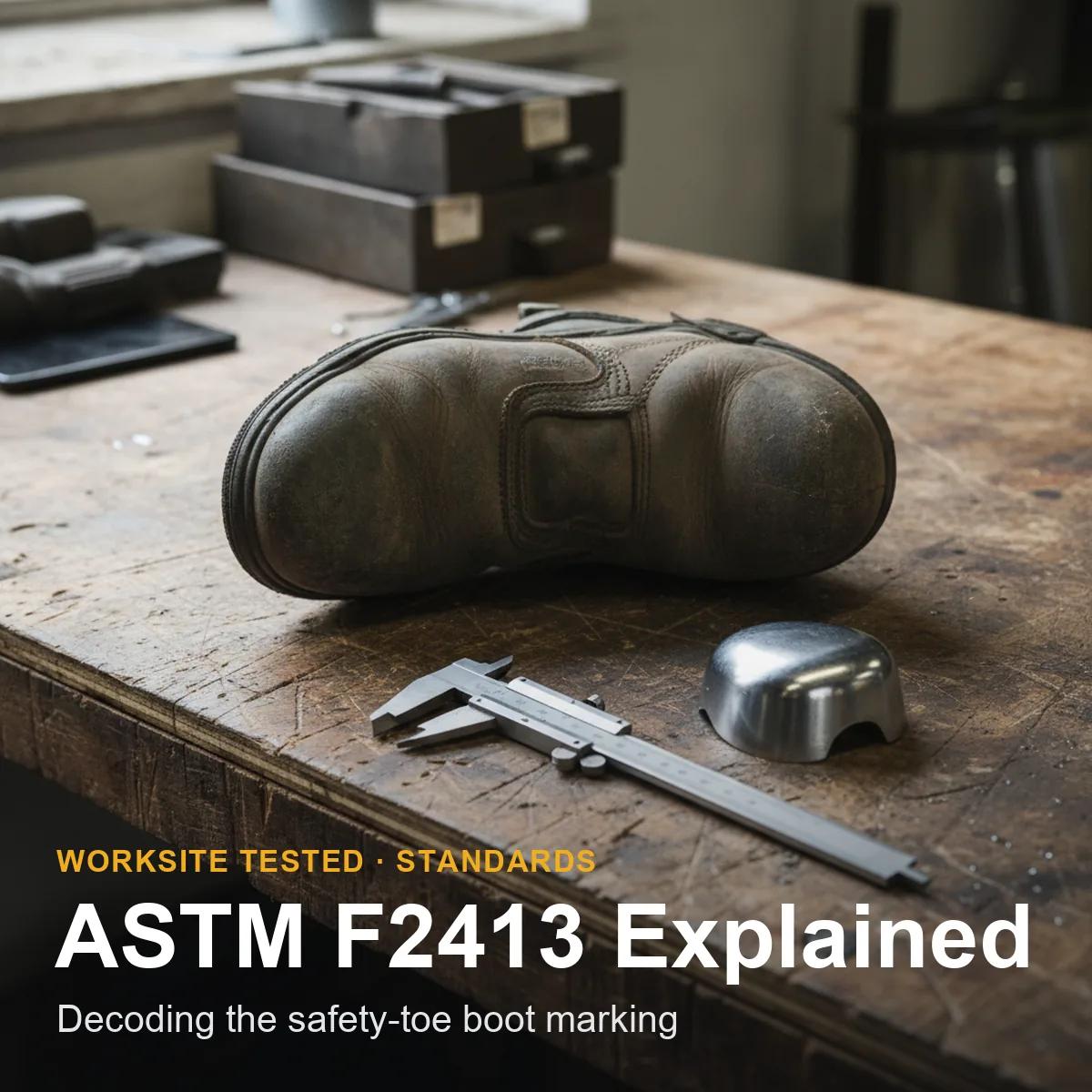
Short answer: the little rectangular stamp inside your boot tongue is the ASTM F2413 marking, and it reads top to bottom like a spec sheet. ASTM F2413-18 tells you the standard and the edition. M I/75 C/75 tells you it's a men's last, the toe cap survived a 75 ft-lbf impact, and it held up under 2,500 lbf of compression. Anything after that — EH, Mt, PR, Cd, SD — is an optional add-on the boot earned on top of the mandatory toe protection. This guide decodes every block of that stamp, with the actual force and voltage numbers behind each code, so you can look at a label and know exactly what the boot does and does not do.
One rule I follow in a safety category: every number here traces back to a published source — the ASTM F2413-11 specification text, Thorogood's rating breakdown, and the OSHA regulation itself. If a source doesn't state it, I don't state it. This is the explainer the boot roundups on this site point up to, so it's worth getting exactly right.
Key Takeaways
- Impact and compression are mandatory; everything else is optional. A boot certified to ASTM F2413 must FIRST pass Section 5.1 (impact) and Section 5.2 (compression). EH, metatarsal, puncture, conductive, and static-dissipative ratings can only be claimed once that base toe protection is met.
- The rating number maps to a force. Compression 75 / 50 / 30 equals 2,500 / 1,750 / 1,000 lbf. I/75 means the toe cap was tested at a 75 ft-lbf (101.7 J) impact; C/75 means 2,500 lbf (11,121 N) of compression. After the test, a men's cap must still hold 0.500 in (1/2 in) of clearance over the toe.
- EH is secondary protection, and it's a dry-condition rating. The sole/heel must withstand 18,000 V at 60 Hz for one minute with no more than 1.0 mA leakage — under dry conditions. It's a backup for incidental contact, not a substitute for de-energizing.
- The optional codes each have a real threshold. Mt/75 = 75 ft-lbf instep protection; PR = a permanent plate rated to at least 270 lbf (1,200 N); SD (static dissipative) = resistance 10^6 to 10^8 ohms; Cd (conductive) = 0 to 500,000 ohms. They are not interchangeable — SD and Cd are near-opposites of EH.
- OSHA references the standard; it doesn't write it. OSHA 29 CFR 1910.136 requires protective footwear where there's a danger of falling/rolling objects, sole punctures, or electrical hazards, and accepts footwear meeting ASTM F-2412/F-2413-2005 (or the older ANSI Z41).
- Where to go next: EH rating, in depth | Best work boots | Best EH boots for electricians
What ASTM F2413 actually is
ASTM F2413-11 is the "Standard Specification for Performance Requirements for Protective (Safety) Toe Cap Footwear." It replaced the former ANSI Z41 standard — which was withdrawn in 2005 — and it covers the minimum design, performance, testing, and classification requirements for footwear meant to protect against workplace hazards. (The number after the dash is the edition year: F2413-11 is the 2011 edition, F2413-18 is the 2018 edition.)
Here's the part most people miss. A boot doesn't get to wear any of the fancy add-on codes unless it first passes the two mandatory sections: Section 5.1, Impact Resistant Footwear, and Section 5.2, Compression Resistant Footwear. Metatarsal, conductive, electrical hazard, static dissipative, and puncture resistance are all optional add-ons — and per the spec, they can only be claimed after the base impact and compression requirements are met. So when you see M I/75 C/75 EH, the EH is riding on top of a toe cap that already passed impact and compression. No I/C, no add-ons. (Source: the UW-hosted ASTM F2413-11 specification.)
Where the marking lives, and how to read the stamp
The ASTM F2413 marking is stamped on one shoe of each pair — on the tongue, gusset, shaft, or quarter lining — enclosed in a rectangular border. The spec recommends a four-line format; line four only gets used when more than three sections of the standard apply. A worked example straight out of the spec:
| Line | What it reads (example) | What it tells you |
|---|---|---|
| Line 1 | ASTM F2413-11 |
The standard and the edition. "-11" = the 2011 edition; "-18" = the 2018 edition. Confirms which version of the spec the footwear was certified to. |
| Line 2 | M I/75 C/75 |
Gender — M (Male) or F (Female) — then impact (I) and compression (C) ratings. Some retailer lines also show a leading Y for youth/child sizing. |
| Line 3 | PR/Mt75 |
Optional add-on sections that apply (here: puncture resistance and a 75 ft-lbf metatarsal guard). |
| Line 4 | (used only if needed) | Only present when more than three sections of the standard apply to the footwear. |
One thing the spec is blunt about: altering the footwear after manufacture — replacing or adding footbeds or inserts — could cause failure of any or all parts of the standard and invalidates the safety marking. So that aftermarket insole you slipped in for arch support? Technically, it can void the certification on the label. (Source: ASTM F2413-11 spec text.)
Line 2: impact (I) and compression (C) — the mandatory core
This is the part of the marking every safety boot carries, because it's the part the standard requires. The number — 75, 50, or 30 — maps to a specific force level. Per the spec: compression ratings of 75 / 50 / 30 equal 2,500 / 1,750 / 1,000 pounds of compression respectively. On the impact side, I/75 means the toe cap was tested at a 75 ft-lbf impact; C/75 means it was tested at 2,500 lbf of compression.
But passing isn't just "the cap didn't break." The standard sets a clearance the cap has to maintain over your toes after the hit:
| Code | Test applied | Men's clearance retained | Women's clearance retained |
|---|---|---|---|
| I/75 (impact) | Nominal impact of 75 foot-pounds (101.7 J) | 0.500 in (1/2 in) or greater | 0.468 in (15/32 in) or greater |
| C/75 (compression) | Compression force of 2,500 lbs (11,121 N) | 0.500 in (1/2 in) or greater | 0.468 in or greater |
So I/75 C/75 isn't marketing — it's a measured outcome: after a 75 ft-lbf drop and a 2,500 lbf squeeze, there's still at least half an inch of room between the inside of the cap and your toes. Class 75 is the top protection tier; class 50 (1,750 lbf compression) is a lower tier. Most American work boots are built to I/75 C/75. (Sources: ASTM F2413-11 spec; Thorogood rating breakdown.)
Line 3: the optional add-on codes (EH, Mt, PR, Cd, SD, and more)
Everything after the I/C block is optional and only valid once the toe passed impact and compression. Here's every code you're likely to see, with the actual threshold behind it.
EH — Electrical Hazard
EH footwear has non-conductive, electric-shock-resistant soles and heels that provide a secondary source of protection against incidental contact with live circuits. The test: the boot must withstand 18,000 volts (RMS) at 60 Hz for one minute with no current flow or leakage in excess of 1.0 milliampere — under dry conditions. Read that last part twice. EH is a backup for incidental contact, it's a dry-condition rating, and protection drops when the boot is wet or worn. It does not replace de-energizing, insulated gloves, or lockout/tagout. I cover this one in depth in the EH-rated boots explainer. (Source: ASTM F2413-11 spec.)
Mt — Metatarsal protection
Mt guards protect the metatarsal bones at the top of the foot from drop hazards — the area between your toes and your ankle that a steel toe does nothing for. Mt/75 footwear retains a 1.0-inch clearance for men's (0.937 in for women's) after a 75 ft-lbf (101.7 J) impact. If you work around dropped pipe, plate, or heavy tooling that can land across the instep, this is the code you want — and most boots don't carry it. (Sources: ASTM F2413-11 spec; Thorogood breakdown. For picks, see best metatarsal-guard boots.)
PR — Puncture Resistant
PR footwear has a puncture-resistant plate that is an integral, permanent part of the boot, sitting between the insole and outsole — not a removable insert. To earn PR, the footwear must show no cracking after 1.5 million flexes and have a minimum puncture resistance of 270 pounds (1,200 N). Any metal plate also has to pass ASTM B117 salt-spray corrosion testing — no corrosion after 24 hours in a 5% salt solution. (Sources: ASTM F2413-11 spec; Thorogood, which states PR as puncture-resisting through the sole at a 1,200 N / 270 lbf load.)
Cd — Conductive
Conductive footwear is the deliberate opposite of EH. It's designed to reduce static build-up and the chance of igniting explosives or volatile chemicals by transferring static charge to ground. Its electrical resistance must fall between zero and 500,000 ohms. You'd see this in explosives handling or certain munitions work — never wear Cd where electric-shock hazard is the concern. (Source: ASTM F2413-11 spec.)
SD — Static Dissipative
SD footwear threads the needle between EH and Cd: it keeps resistance high enough to reduce the chance of electric shock while still bleeding off static. The spec sets a lower limit of 10^6 ohms (1,000,000 / 1 megohm) and an upper limit of 10^8 ohms (100,000,000 / 100 megohms). This is the electronics-and-cleanroom rating — you want static gone, but you don't want a dead short to ground. (Source: ASTM F2413-11 spec.)
DI and chainsaw cut — the less common ones
The standard also covers dielectric insulation (DI) and chainsaw cut resistance among the optional performance categories a boot can be certified for, in addition to the mandatory impact and compression. You'll see these on specialized footwear (utility, forestry); most general work boots don't carry them. (Source: ASTM F2413-11 spec.)
Putting it together: a full marking, decoded
Take a label that reads ASTM F2413-18 M I/75 C/75 EH. Here's every block:
| Block | Meaning | The number behind it |
|---|---|---|
ASTM F2413-18 |
Standard + edition (2018) | Confirms the spec version certified to |
M |
Men's sizing | (F = women's; some retailer lines add a leading Y for youth) |
I/75 |
Impact resistance, class 75 | Tested at 75 ft-lbf (101.7 J); cap retains 0.500 in clearance (men's) |
C/75 |
Compression resistance, class 75 | Tested at 2,500 lbf (11,121 N); cap retains 0.500 in clearance (men's) |
EH |
Electrical Hazard (secondary) | Withstands 18,000 V at 60 Hz for 1 min, ≤ 1.0 mA leakage, dry conditions |
Five blocks, five facts. Nothing in that line is decorative — each piece is a tested threshold. And nothing about EH on the end changes the toe rating: the I/75 C/75 is still the mandatory core. (Sources: ASTM F2413-11 spec; Thorogood rating breakdown.)
Does OSHA require ASTM F2413 boots?
OSHA requires protective footwear, and it points to ASTM to define what "protective" means — but it doesn't write the boot spec itself. The regulation, OSHA 29 CFR 1910.136(a), reads:
"The employer shall ensure that each affected employee uses protective footwear when working in areas where there is a danger of foot injuries due to falling or rolling objects, or objects piercing the sole, or when the use of protective footwear will protect the affected employee from an electrical hazard, such as a static-discharge or electric-shock hazard, that remains after the employer takes other necessary protective measures."
For the "what counts as protective" part, 1910.136 accepts footwear that complies with consensus standards including ASTM F-2412-2005 and ASTM F-2413-2005, or ANSI Z41-1999, or ANSI Z41-1991. Footwear the employer can demonstrate to be equally effective is also permitted. In plain terms: OSHA incorporates the ASTM standard by reference, so a boot marked to F2413 satisfies the footwear requirement where your job hazard analysis calls for it. (Source: osha.gov, 29 CFR 1910.136.)
Frequently Asked Questions
What does ASTM F2413-18 M I/75 C/75 EH mean on a work boot?
Read it block by block: "ASTM F2413-18" is the standard and edition (2018); "M" = men's sizing; "I/75" = impact tested at 75 ft-lbf; "C/75" = compression tested at 2,500 lbf; "EH" = an electrical-hazard sole rated to withstand 18,000 V at 60 Hz for one minute with leakage under 1.0 mA, under dry conditions. Sourced from the ASTM F2413-11 spec text and Thorogood's rating breakdown.
What is the difference between class 75 and class 50 (I/75 vs I/50, C/75 vs C/50)?
The rating number maps to a force. Per the ASTM F2413-11 marking text, compression 75 / 50 / 30 = 2,500 / 1,750 / 1,000 lbf, and 75 ft-lbf is the impact level for class 75. Class 75 is the higher protection tier; class 50 is a lower tier. Most American work boots are built to class 75. (Source: the UW-hosted ASTM F2413-11 document.)
What does EH (electrical hazard) actually protect against, and is it shock-proof?
EH soles and heels are a secondary, incidental-contact protection — the boot must withstand 18,000 V at 60 Hz for one minute with no more than 1.0 mA leakage under DRY conditions. It is not a primary insulator, and protection drops when the boot is wet or worn. It never replaces de-energizing the circuit. (Source: ASTM F2413-11 spec text.)
What do Mt, PR, SD, Cd, and DI mean?
Mt = metatarsal guard (Mt/75 = 75 ft-lbf instep protection). PR = a permanent puncture-resistant plate, minimum 270 lbf / 1,200 N. SD = static dissipative (resistance 10^6 to 10^8 ohms). Cd = conductive (0 to 500,000 ohms). DI = dielectric insulation. All sourced from the ASTM F2413-11 spec and Thorogood's breakdown.
Does OSHA require ASTM F2413 boots?
OSHA 29 CFR 1910.136 requires protective footwear where there's danger of falling or rolling objects, sole punctures, or electrical hazards, and it accepts footwear meeting ASTM F-2412/F-2413-2005 (or the older ANSI Z41). OSHA doesn't write the boot spec itself — it incorporates the ASTM consensus standard by reference. (Source: osha.gov, 1910.136.)
Where is the ASTM F2413 marking located on a boot?
One shoe of each pair is marked inside a rectangular border on the tongue, gusset, shaft, or quarter lining, in a recommended four-line format. Note that adding aftermarket insoles or footbeds can invalidate the marking, because altering the footwear after manufacture may cause it to fail part of the standard. (Source: ASTM F2413-11 spec text.)
Why Trust This Guide
This guide is written and reviewed by Marco Reyes, an independent work-safety-gear reviewer. Every recommendation is built on the published standards (ASTM F2413 for footwear, ANSI Z359 for fall protection, ANSI/ISEA 107 for hi-vis, the OSHA rules), manufacturer spec sheets and product labels, hands-on handling, and what tradespeople actually report — and we tell you when a number is a manufacturer claim versus an independent standard, and when a boot is rated for one hazard but not another. The standard numbers in this explainer come from the ASTM F2413-11 specification text, Thorogood's published rating breakdown, and OSHA 29 CFR 1910.136, all fetched June 28, 2026. We earn an affiliate commission if you buy through some of our links, at no extra cost to you, and we never rank by commission over safety — see our affiliate disclosure.