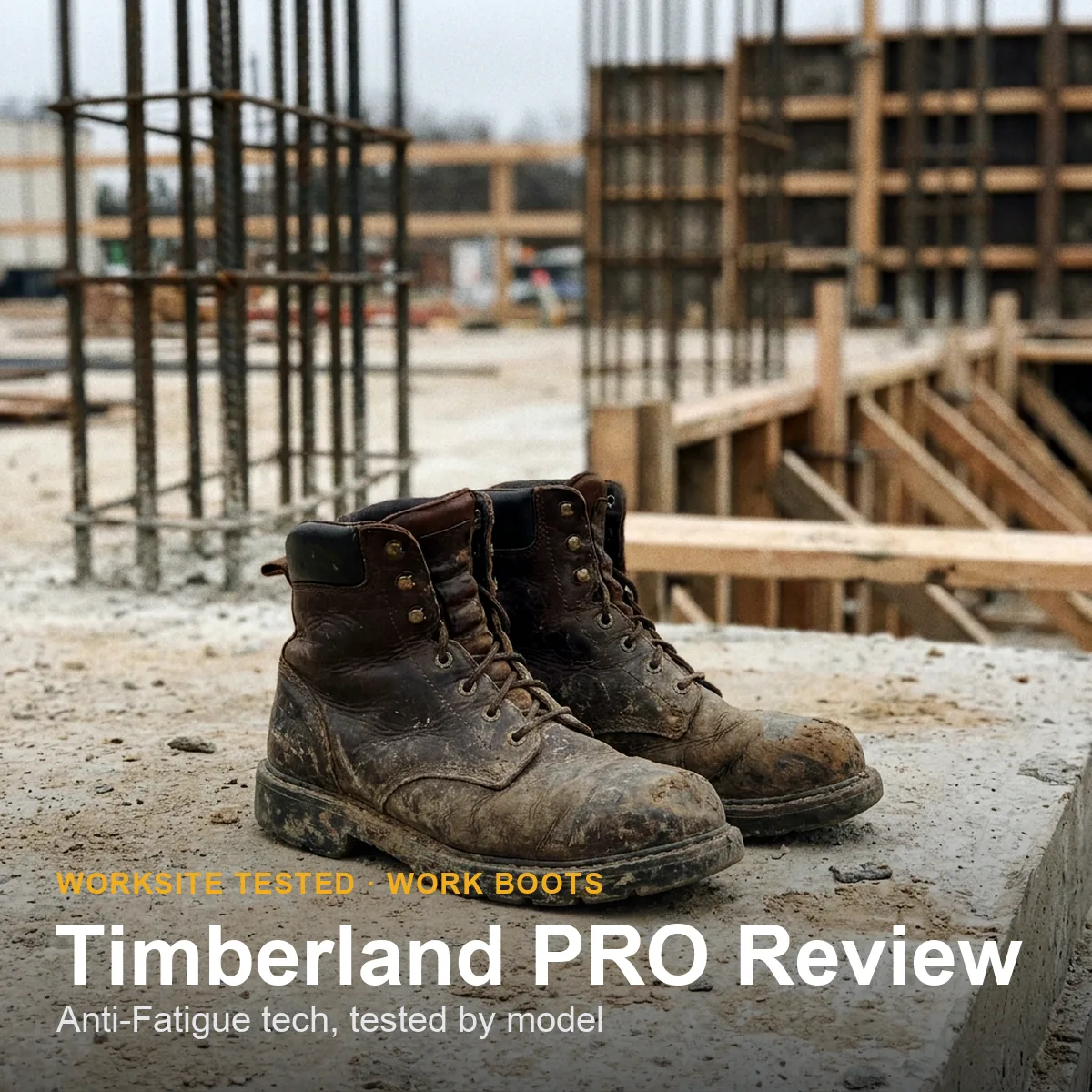

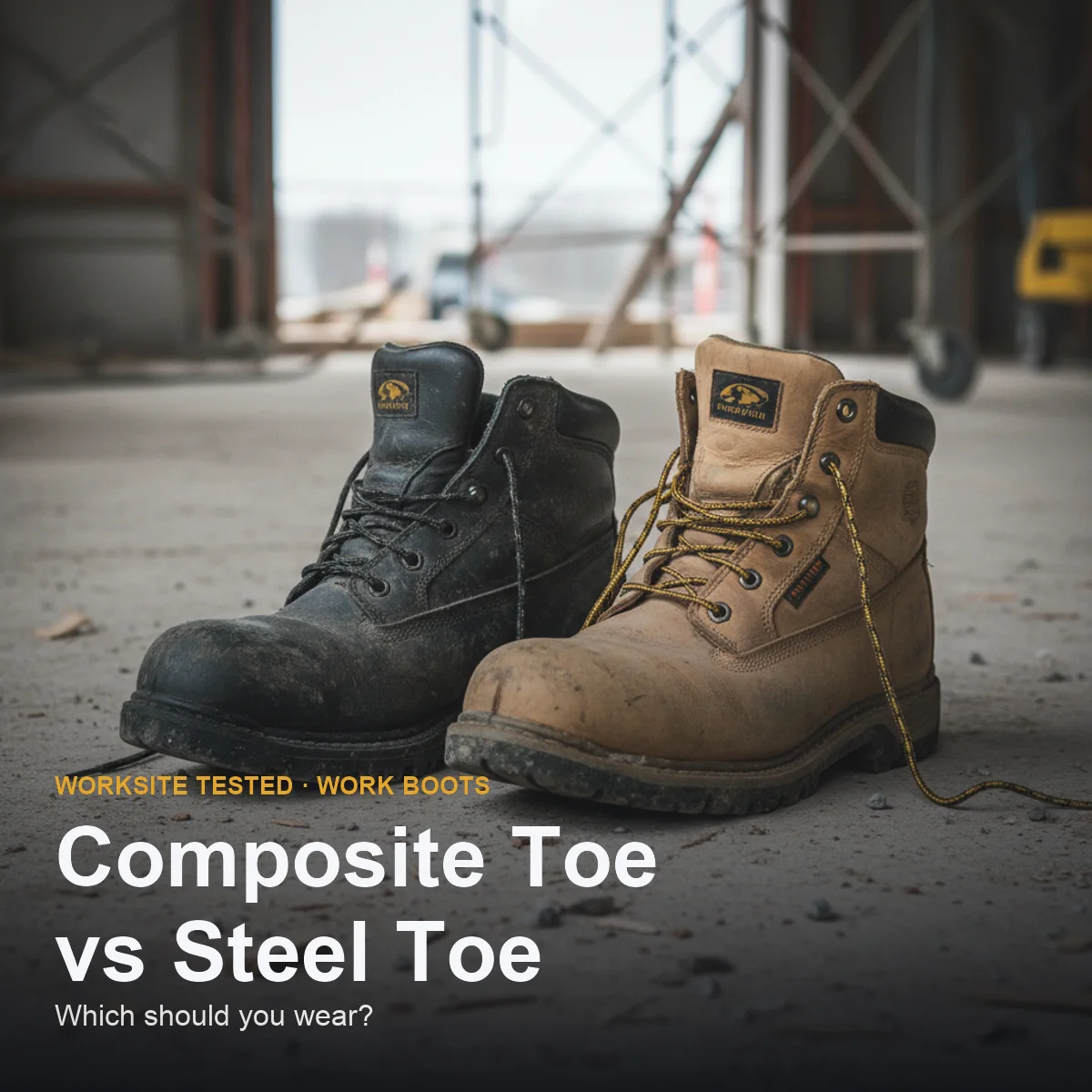
Short answer: both composite toe and steel toe boots can carry the exact same ASTM F2413 I/75 C/75 safety rating. The standard does not care what the cap is made of — it cares how much force the cap survives. So if your job requires ASTM-rated safety toe, either type passes. The choice comes down to weight, temperature, whether you cross a metal detector, and what kind of electrical hazard you face. I will break it down trade by trade.
Bottom Line First
- Same protection rating, different materials. ASTM F2413 I/75 C/75 on a composite toe and on a steel toe means both survived the same 75 ft-lbf impact and 2,500 lbf compression test. The material is not the rating.
- Composite wins for metal detectors, EH, and hot environments. No metal to conduct heat or cold; no alarm at security checkpoints; composite-toe boots are easier to get an EH (Electrical Hazard) rating on because the cap itself is non-conductive.
- Steel wins for raw durability and cold-temperature performance. Steel does not flex or crack over years of hard use. In freezing temps, both conduct differently — but the comfort edge in cold shifts to how well the boot is insulated, not which toe cap you chose.
- Weight difference exists but listings rarely publish it. None of the boots in this guide list a weight on the product page. If weight is your deciding factor, read reviews from people who have worn both.
- EH is secondary protection only. Per the standards, EH-rated footwear insulates the outsole and heel against open circuits up to 18,000 V at 60 Hz under dry conditions. It is not primary electrical insulation PPE. Do not treat it as a substitute for rubber-insulating gloves or blankets.
What ASTM F2413 actually says — in plain terms
OSHA 29 CFR 1910.136 (general industry) and 29 CFR 1926.96 (construction) require foot protection when there is danger from falling objects, rolling objects, objects piercing the sole, or electrical hazards. The regulation references ASTM F2413 as a recognized compliance standard. Here is how to read the stamp inside your boot.
The ASTM F2413 marking is stamped inside the boot, typically on up to four lines:
- Line 1: Standard designation and year — for example, ASTM F2413-11 or ASTM F2413-18. (The current widely-referenced version is F2413-18; F2413-24 is now published. Many product database entries still reference F2413-05 or F2413-11, which were the versions in force when those products were originally listed. OSHA recognizes boots compliant with current versions.)
- Line 2: Gender (M or F) and toe protection ratings — for example, M I/75 C/75.
- Lines 3-4: Supplemental protection codes: EH, PR, Mt, SD, Cd, and others.
| Code | What it means | Test threshold (men's I/75 or C/75) |
|---|---|---|
| I/75 | Impact: toe cap survives 75 ft-lbf; interior must maintain ≥ 0.5 in clearance | 75 ft-lbf drop |
| C/75 | Compression: toe area survives 2,500 lbf crush; same clearance requirement | 2,500 lbf |
| EH | Electrical Hazard: outsole + heel insulate against 18,000 V at 60 Hz, dry conditions — secondary protection only | 18,000 V open circuit |
| PR | Puncture Resistant: a plate between insole and outsole resists sharp object penetration | Sole puncture test |
| Mt/75 | Metatarsal Protection: guards instep/top of foot from impact; same 75 ft-lbf test applied to the metatarsal zone | 75 ft-lbf to metatarsal |
| SD | Static Dissipative: controls static buildup while retaining resistance — used in electronics environments. Three levels: SD10, SD35, SD100 | Static dissipation test |
| Cd | Conductive: drains static to ground for explosive atmospheres — do NOT use for electrical work | Conductivity test |
Key point: I/75 C/75 is I/75 C/75 regardless of whether the cap is steel or composite. The standard sets a performance threshold, not a material. A composite cap made of fiberglass, carbon fiber, or nanocomposite plastic that passes the test is rated identically to a steel cap that passes the same test. Source: Tyndale USA, ASTM F2413 footwear standards explainer (fetched 2026-06-27).
The real differences on a 10-hour shift
Weight
Composite toe caps are generally lighter than steel caps. How much lighter varies by boot construction, and none of the boots in this guide publish a weight on the listing — so I am not going to give you a number I do not have. What tradespeople consistently report: a lighter toe cap is noticeable over a 10-hour shift on concrete, especially for ironworkers and roofers climbing ladders. If you are on a forklift all day, the difference matters less.
Temperature and conductivity
Steel conducts heat and cold. On a blacktop parking lot in August, a steel toe cap can get uncomfortably hot against your toes. In a walk-in freezer or a January framing job, it can get cold. Composite materials do not conduct temperature the same way — they insulate better. This is a real difference for workers in temperature extremes. It is not a safety-rating difference; it is a comfort difference that affects whether you can focus on the job.
Metal detectors and security checkpoints
Airport workers, courthouse workers, nuclear plant workers, semiconductor facilities — anywhere you pass a metal detector daily, a steel toe cap sets off the alarm. A composite toe does not. This is purely an operational convenience, but if you clear security five times a shift, it adds up.
Electrical hazard and EH ratings
An EH-rated boot has an outsole and heel that insulate against open circuits up to 18,000 V at 60 Hz under dry conditions. The EH code on your boot's stamp is about the outsole, not the toe cap. Steel toe boots can carry EH ratings — the Timberland PRO Rigmaster in this guide does. But because a composite toe cap is itself non-conductive, some workers in electrical trades prefer composite boots for the added layer of non-metallic-throughout protection. That preference is logical; it is not an ASTM requirement.
If you work live electrical: EH is secondary protection. Your primary protection is NFPA 70E-compliant rubber-insulating gloves, blankets, and sleeves rated for your task. Do not let an EH boot marking substitute for proper electrical PPE.
Durability and service life
Steel does not crack under repeated impact. Some carbon-fiber and nanocomposite toe caps can develop micro-fractures over years of hard abuse — dropping heavy steel on them repeatedly, every shift. It is not universal, but it is a real field complaint. If your boots see constant heavy-object impacts (foundry, heavy fabrication, loading dock), steel's edge on long-term structural integrity is worth considering. The Thorogood Goodyear-welt boot in this guide can also be resoled when the outsole wears out; most cement-sole composites cannot.
By trade: which one to grab
| Trade / setting | Better choice | Why |
|---|---|---|
| Electrician / lineman / utility | Composite (EH-rated) | Non-metallic throughout; EH outsole; no conductive cap. Get boots stamped EH. |
| Electronics / semiconductor / clean room | Composite (SD-rated) | No metal; SD rating controls static buildup without discharging to ground (which Cd does — wrong for electrical environments). |
| Airport / secure-facility worker | Composite | No metal-detector alarm. Daily checkpoint headache eliminated. |
| Roofer / carpenter / framer | Composite or steel | Weight advantage of composite matters on ladders. EH useful on jobsites before electrical is grounded. Either works. |
| Ironworker / structural steel / crane operator | Steel or composite (your call) | Heavy falling objects favor steel's long-term durability. Both pass the same I/75 C/75 test on day one. |
| Foundry / heavy fabrication | Steel (consider Mt/75 too) | Constant heavy impact; steel holds up longer. If metatarsal protection required, look for Mt/75 stamp. |
| Cold-storage / freezer / outdoor winter | Composite | Non-conducting cap does not transfer cold the same way. Still need insulated boot overall. |
| Hot outdoor / summer concrete work | Composite | Steel cap conducts heat; composite insulates better. |
| Oilfield / pipeline (metatarsal hazard) | Either, with Mt/75 | Get the metatarsal guard — that is the critical rating here, not composite vs steel. |
Three boots worth knowing about
These are real in-stock listings as of 2026-06-27. Every spec comes from the live product page. Where a spec is not on the listing, I say so rather than guess.
Composite, non-EH: Carolina CA5556 — $169.99
A 6-inch cement-sole composite-toe boot for everyday trade work. The listing states ASTM F2413-05 M I/75 C/75 and claims static-dissipative (SD) protection. No EH on this one — if you need electrical-hazard protection, look at the Justin boot below. The Utopia Cafe leather upper and aggressive rubber outsole make it a solid daily driver for carpenters, general contractors, and anyone doing mixed interior/exterior work who passes a metal detector. Weight is not listed on the product page. Price: $169.99, in stock.
Check price at Working Person's Store — Carolina CA5556 composite toe
Composite + EH: Justin SE4824 — $169.95
The composite boot I would hand an electrician or utility worker. The listing states ASTM F2413-11 M I/75 C/75 EH — non-metallic toe, EH-rated outsole. The Stampede dual-density rubber outsole is slip resistant. The listing does not specify closure style. Price: $169.95, in stock. No weight listed on the product page. Remember: EH is secondary protection only — it does not replace properly rated rubber-insulating gloves and sleeves for live electrical work.
Check price at Working Person's Store — Justin SE4824 composite EH
Steel toe: Thorogood 804-4398 — $284.95
A Goodyear-welt, Made-in-USA, 8-inch moc-toe steel boot on a MAXWear 90 outsole. The listing states ASTM F2413-05 M I/75 C/75 and EH. This one costs more up front, but a Goodyear-welt boot can be resoled — a cement-sole boot usually cannot. For tradespeople who want one pair that lasts five or more years with resoling, that math works. Full-grain American leather upper. The steel toe is heavier than composite and conducts temperature, but it does not crack. Price: $284.95, in stock. No weight listed on product page.
Check price at Working Person's Store — Thorogood 804-4398 steel toe
Marketing claims to watch out for
A few things show up constantly in boot marketing that are worth cutting through:
- "ANSI-rated" on older listings often means ANSI Z41-1999 or ANSI Z41PT99. ANSI Z41 has been withdrawn and replaced by ASTM F2413. OSHA recognizes current ASTM F2413 compliance. The Timberland PRO Rigmaster listing in the research kit cites both ASTM F2413-05 and ANSI Z41PT99 — that is a legacy dual-cite common in older product entries. The ASTM F2413 stamp is the one that matters for current compliance.
- "Carbon fiber toe" and "nano toe" are marketing names for composite materials. They carry ASTM F2413 ratings like any other composite if they pass the test. They are not inherently stronger than fiberglass composites — they just market better.
- "200-joule protection" is a European EN ISO 20345 rating, not an ASTM rating. If your jobsite is in the US and covered by OSHA 29 CFR 1910.136 or 1926.96, the relevant standard is ASTM F2413. Do not assume a European CE mark satisfies US OSHA requirements.
- No published weight. None of the boots on Working Person's Store product pages I checked for this article publish a boot weight. If a review site or manufacturer ad gives you a precise weight figure, ask where it came from before relying on it.
Frequently Asked Questions
Do composite toe and steel toe offer the same protection?
If both are stamped ASTM F2413 I/75 C/75, yes — they passed the same impact and compression tests. ASTM F2413 mandates performance, not material. A boot's safety rating comes from the stamp inside the boot, not from what the cap is made of.
Is composite toe better for electrical work?
Composite toe is non-metallic, which is preferred in fully non-metallic boot constructions for electrical work. For OSHA-recognized electrical hazard protection, look for the EH stamp on line 3 or 4 of the ASTM F2413 marking inside the boot — that covers the outsole and heel against 18,000 V open circuits under dry conditions. EH is secondary protection; it does not replace primary electrical PPE like rubber-insulating gloves.
Does steel toe get cold in winter?
Steel conducts temperature. In cold conditions, a steel cap can feel colder against your toes than a composite cap. The bigger factor is how well the entire boot is insulated. That said, if you work in a freezer or harsh winter conditions, composite toe eliminates the conduction issue entirely.
Does OSHA require a specific toe type?
No. OSHA 29 CFR 1910.136 requires protective footwear meeting recognized consensus standards (ASTM F2413 or ANSI Z41) in areas with foot-injury hazards. It does not require steel vs composite — it requires the performance standard be met. Your employer's site-specific PPE assessment determines whether safety-toe footwear is required at all, and what additional codes (EH, PR, Mt) apply to your task.
Will composite toe set off a metal detector?
A standard composite toe cap made of fiberglass, carbon fiber, or nanocomposite plastics will not trigger a metal detector. If the boot has other metal components — steel shank, steel hardware, eyelets — those may still trigger depending on the detector sensitivity. Check all components, not just the toe cap.
Why Trust This Guide
This guide is written by Marco Reyes, a bilingual (EN/es-US) jobsite reviewer. Every spec comes directly from a live product listing fetched on 2026-06-27 — if a number was not on the listing, it is not in this article. Standards facts (ASTM F2413 markings, OSHA regulation citations, EH voltage ratings) are sourced from OSHA.gov and industry technical references, and manufacturer claims are labeled separately from independently verified standards. We earn an affiliate commission if you buy through links on this page, at no additional cost to you — it does not affect what we recommend or how we rank. See our affiliate disclosure.